Friday, October 8, 2010

There’s no such as “normal” weather in Guatemala…but trees can help!


An AIR-planted pine forest, about 8 years old in Simajhuleu, Guatemala, stopping a mudslide from the road above and protecting a stream and houses below (June 2010; photo: A. Hallum)

Last June we updated you how trees planted by our planting partner AIR in Guatemala help to mitigate some damages of Hurricane Agatha.

AIR is doing an incredible job in Guatemala in general, but in such situations its work is even more substantial. This is also a demonstration of the value of trees planted by AIR and their significant impact on people's life.

Dr. Anne Hallum, the Director of AIR, who was in Guatemala at that time with a team of volunteers to plant trees as this was the planting season, sent us a brief report, which is enclosed below, on the event with pictures that help to get a better understanding what happened there.

There’s no such as “normal” weather in Guatemala…but trees can help!

The last day of May, 2010, tropical storm Agatha poured so m
uch rain on south central Guatemala, it caused horrific flooding and mudslides that killed at least 145 people, washed away crops and highways, and hundreds of homes. Particularly hard hit was the Department of Chimaltenango where AIR works.

Some scientists speculate that climate change has changed the normal afternoon rains of the rainy season into intense “rain events.” It doesn’t help that decades of deforestation have worsened the mudslides, and that highway construction and gravel mining in the mountains takes down more trees, and safer engineering practices are not used.

In any case, the rains continued throughout the summer months (Guatemala’s “winter” months). In September “Tropical Depression 11-E” parked for days over the same area of Guatemala, and mudslides destroyed highways and one bus filled with persons was buried, killing at least 12 persons. One of AIR’s technicians was trapped on a road all night outside of Panajachel, with mudslides occurring around him.

What is to be done? First, AIR is responding with targeted emergency aid because the technicians are themselves Guatemalan and know the roads and villages very well. Secondly, volunteers have already been recruited to help rebuild homes—once it stops raining every day. Thirdly, the tree-planting efforts must intensify in these mountainous regions.

It was evident to everyone this summer, that where AIRES had reforested hillsides, the mudslides did not occur. In one village, a young pine forest that AIR had planted 8 years ago acted like brakes on a mudslide washing down a road and protected the stream and houses below. As the AIR technician said, “the little trees stood like soldiers” stopping the mud (photo).


AIR staff members & truck delivering food & water, in Santa Apolonia, 2 June 2010 (Photo: A. Hallum)


The benefits of trees seem innumerable – animal habitat, soil nutrition; shade; beauty; fertilizer; fruits, carbon sequestration—and this summer in Guatemala, they literally saved lives.

Josue, standing next to an AIR-planted forest in Simajhuleu, Guatemala; his family has worked with AIR for 10 years (Photo: A. Hallum)


AIR tree nursery; Santa Apolonia; Rebecca Hallum, Anne Hallum, with Luis Iquique and the resident committee, June 2010 (photo: A. Hallum)

For more information, and to donate for AIR’s emergency response, see www2.stetson.edu/air/

Yours,
Raz @ Eco-Libris

Eco-Libris: Promoting sustainable reading!


Wednesday, October 6, 2010

Are publishers and bookstores in the same boat when it comes to e-books?

Not too long ago it looked like the book industry is a unite front when it comes to dealing with the new challenges of the digital era. When talking about the the future of books or trying to answer questions like 'Is Print Dead?', the general notion was that bookstores and publishers are in the same boat.

But are they?


I believe that right now the answer is no. While both publishers and bookstores need to deal with difficult challenges, it looks like publishers in general are better positioned than bookstores.

Here is some evidence: Let's start with publishers. Last month Publishers Weekly reported on the results of the five largest trade publishers in the US:

"Four of the five houses reported significant changes in their operating performance in the first half of 2010 compared to one year ago, with big books, or the lack thereof, playing a major role in the shifts...In general, the major houses were optimistic about the second half of the year."


On the other hand, when it comes to bookstores the headlines aren't that positive:


Does The Independent Bookstore Have A Future?
(Treehugger, October 4, 2010)

Borders Posts Net Loss of $46.7 Million for 2Q
(GalleyCat, September 1, 2010)

Barnes & Noble to Shutter Upper West Side Superstore in NYC
(GalleyCat, August 31, 2010)

Now, this is of course generalization, as you still have many publishers struggling and new bookstores that are opened, but I believe it reflects the current state of the book industry, where bookstores have much harder time to adjust to the e-book era than publishers.


Don't get me wrong. Publishers have their own unique challenges to deal with and you can find some of them on a great piece that Stephen Page wrote on the Guardian ("
The future of publishing takes shape"). Still, it looks as publishers have more flexibility and capabilities than bookstores to meet the new e-challenges. As Publishers Weekly reports from "This year, e-books are looked at more as an opportunity than a threat." And yes, it is referring only to publishers.

At least for now.
Both bookstores and publishers are making more money from sales of e-books -B&N CEO reported last month to investoers that "over the last two quarters, these eBook sales have been driving the growth of our BN" and, according to Publishers Weekly, at the end of June, e-book sales accounted for about 8% of adult sales at the publishers. Still, book sales at bookstores are declining while publishers manage to show better performance. Contradiction? Not really. Readers just go elsewhere to buy their books, paper or electronic.

The conclusion is that publishers look more prepared for a hybrid future of both paper and electronic books, although they still have to prove they are capable to adjust their traditional business model to the new era and be able to provide an added value to both writers and readers. Bookstores still need to figure out how to respond to the e-book challenge. If for publishers, e-books begin to look like more as an opportunity, then to bookstores, it's still both a risk and an opportunity.

Yours,
Raz @ Eco-Libris

Plant a tree for every book you read!

Tuesday, October 5, 2010

Happy birthday to Kate Winslet, Grant Hill and all the others who celebrate their birthday today!

What's the connection between musician Bob Geldof, actress Kate Winslet, artist Maya Lin and basketball player Grant Hill?

They were all born on October 5! If you're also celebrating your birthday today - happy birthday to you too!

We love birthdays and therefore we're happy to remind you of the option to celebrate a birthday of friends, family members, colleagues and anyone you care about with Eco-Libris!

Eco-Libris is offering you now to plant trees to balance out the books of your loved ones who celebrate their birthday. Not only that new trees will be planted to balance out their books, but they will also receive our stickers with a beautiful birthday card made of recycled paper. And we also try to keep it affordable - the added charge for the birthday card is only $1.5.

All you need to do is to choose how many of the birthday person's books you want to balance out on our
special birthday gift page (http://www.ecolibris.net/birthday.asp), change the shipping address on the payment page to the address of the gift receiver and we will take care of the rest!

This is also a great green add-on if you're buying a book as a gift for the birthday person, especially if you're buying her or him a green book.

The birthday cards we send are made by
Doodle Greetings (see picture above of one of their cards). Not only these cards come with a beautiful design, but they are also eco-friendly - printed on 100% post-consumer recycled paper and are made chlorine-free and acid free. Sounds like a good fit with Eco-Libris stickers!

And of course, if it's your birthday and you want to give yourself a green gift - get yourself a nice green book and plant a tree for it with us!

Happy Birthday!
Raz @ Eco-Libris

Eco-Libris: promoting sustainable reading!

Sunday, October 3, 2010

We still have room for bloggers who want to join the 2010 Green Books Campaign!

The second Green Books Campaign is taking place in 5 weeks and we still have room for bloggers who are interested in joining and be part of a joint effort to promote books that are printed sustainably.

Here are the details:


Last November, as part of our efforts to promote books that are printed in an eco-friendly manner, we initiated a Green Books Campaign, where over 100 bloggers simultaneously published reviews of more than 100 books printed on recycled or FSC-certified paper. This campaign also involved 40 publishers from the U.S., Canada and the U.K.

The campaign last year was very successful - more than 15,000 readers were exposed to the campaign and it received very positive feedback from publishers, bloggers and readers.

Therefore, we decided to run the campaign again this November, but this time with 200 bloggers! Also, this year we are also collaborating with Indigo Books and Music, the largest book retailer in Canada to increase the campaign's impact and reach.


Just like last year, the idea is to have 200 bloggers, who review books on regular basis, to simultaneously publish their book review of a "green book" of their choice on Wednesday, November 10 2010. Our goal also hasn't changed: To use the power of the internet and social media to promote "green" books and increase the awareness of both readers and publishers to the way books can be printed printed in an eco-friendly manner.

As I said, we still have room for bloggers who want to participate! So if you're interested, the list of participating
books that is available at www.ecolibris.net/greenbookscampaign_list.pdf (Please note that it's recommended to increase the magnification of the web page up to 125% to see all the details).

The books will be assigned on first come first served basis. Once a book is taken, the name of the blog will appear next to it in the column 'assigned blog' (please check this column carefully to see which books are still available for review). So if you find a book that you would like to review on the campaign, just send us an email to info@ecolibris.net with your details.

Yours,
Raz @ Eco-Libris

Thursday, September 30, 2010

Asia Pulp & Paper (APP) - good or bad? ITS is saying APP is good and actually Greenpeace is bad!

We had an interesting discussion going on here on the paper company APP and its operations in Indonesia.

We interviewed Ian Lifshitz, APP's Sustainability & Public Outreach Manager at Asia Pulp & Paper. Ian presented in the interview APP's point of view regarding the company's activities and the accusations against it. One of the issues discussed in the interview was a Greenpeace report "How Sinar Mas is pulping the planet", where Greenpeace claimed that APP "is destroying Indonesia’s rainforests and carbon-rich peatlands."

Afterwards we interviewed Rolf Skar, Senior Campaigner at Greenpeace, who responded to the interview with Ian and presented Greenpeace's position in this case.

Now, we have a third party that is getting involved in this debate, defending APP and accusing Greenpeace in making false accusations against APP. This is International Trade Strategies Pty Ltd, trading as ITS Global Asia Pacific (ITS Global), which consults on dynamic international issues. According to their press release, ITS Global focuses on four core areas: international trade, environmental policy, development aid and strategy and communication. ITS skills are research, policy analysis and corporate affairs and communications strategies.

ITS is claiming to present a peer-reviewed audit. According to the press release, "the audit systematically analyzed 72 Greenpeace claims against APP that included more than 300 footnotes and approximately 100 references. The evidence shows that Greenpeace provided quotes that don’t exist; maps that show concessions that don’t exist; and used source material with high margins of error that was cited as absolute fact, said Alan Oxley, chief executive office of the Melbourne-based ITS Global."

The press release adds that "ITS Global commissioned two independent academic experts, one in forestry and economics and the other in agricultural science, to review Greenpeace’s claims. The audit shows that both describe the Greenpeace report as “highly misleading." No names attached.

You can see Alan Oxley, Managing Director of ITS and the Chairman of the Australian APEC Study Centre and Founder of WorldGrowth presenting ITS' audit in this video:


The audit itself is available here: http://www.scribd.com/doc/38102388/ITS-Global-Greenpeace-Audit-Report

So what do you think? Is this audit the crucial proof APP was looking for to show that they're right and Greenpeace is wrong? I don't know..One thing I do know is that this is not the final word in this debate. We'll try to have Rolf's response to this audit and see what Greenpeace has to say about these allegations against its report.

UPDATES:

1. Check out what Rehtt Buttler at Mongabay.com has to say about this audit ("
Asia Pulp & Paper hires its PR firm to do a hit job on Greenpeace but comes up short"). Thanks to Peter Nowack (@printleadership) for the reference to this excellent article!

2. Here's Greenpeace's response to the audit -http://photos.mongabay.com/10/Greenpeace-Response-to-ITS-Global-Sept-2010.pdf

Yours,
Raz @ Eco-Libris


Eco-Libris: Promoting sustainable reading!

Tuesday, September 28, 2010

Want some candies? Go to Strand!

If you needed another reason to go to Strand Bookstore, which is taking part in our bookstores program, we've got it for you and it's as sweet as it can get!

The New York Daily News reported yesterday (and thanks to mediabistro.com: GalleyCat for the link) that "customers are abuzz over a newly built Candyland on the shelves beneath the 40-foot-long checkout counter at the Union Square used-book mecca."

Customers, according to the article, can find there Old-fashioned sweets like $2.95 boxes of Gobstoppers, $1.95 chewable wax lips and three-for-35-cents Pixy Stix.

The reason is very simple - another way to generate income, especially from those who just browse the books in the store, as Fred Bass, Strand co-owner
, explains on the article (he's the one standing on the photo above in front of the candy shelves).

Candies are of course just the tip of the iceberg when it comes to considering a visit in the store.
Located in 828 Broadway (at 12th St.), this New York's independent landmark bookstore is one of most famous bookstores in the world. As mediabistro.com: GalleyCat reminds us Strand "boasts an 18-mile collection's worth of new, used, rare, and out-of-print books. Some of the rare titles include a first-edition of Lewis Baltz's Park City, a signed first-edition of Hunter S. Thompson's Kingdom of Fear, and a signed complete set of the Writings of Mark Twain: Definitive Edition. The last collector's item will set a buyer back $5,500."

And of course customers at Strand can plant a tree for every book they buy there and receive our sticker at the counter!

Saturday, September 25, 2010

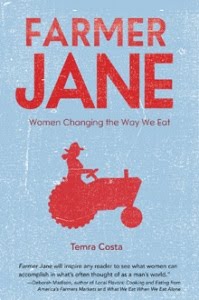
Green book of the week: Farmer Jane by Temra Costa (including an interview with the author)


If you were surprised by the fact that Michelle Obama took last Friday the spouses of 32 world leaders on a trip to the Stone Barns Center for Food and Agriculture in New York, then you really shouldn't. Sustainable and local food is becoming an increasingly significant topic and the First Lady is one of its leading supporters.


And she is not the only woman involved in this growing industry. A growing number of women is dominating the field and 30 of them are profiled in the new book of Temra Costa, Farmer Jane, which is our green book of the week.

Here are some more details about this book:

Title: Farmer Jane: Women Changing The Way We Eat

What the book is about:
Farmer Jane profiles thirty women in the sustainable food industry, describing their agriculture and business models and illustrating the amazing changes they are making in how we connect with food. These advocates for creating a more holistic and nurturing food and agriculture system also answer questions on starting a community-supported agriculture (CSA) program, how to get involved in policy at local and national levels, and how to address the different types of renewable energy and finance them.

Author: Temra Costa
Temra Costa is a nationally recognized sustainable food and farming advocate. She has written for numerous publications on hot-button issues such as Farm to School, eating locally, food safety, and how to create regional food systems. Her previous role as statewide director of California’s Buy Fresh Buy Local campaign, and other positions held with Community Alliance with Family Farmers (CAFF), worked to engage stakeholders in our food system, from farm to fridge.

Temra works, cooks, gardens and writes in the East Bay of California. She's a radio show co-host on Green 960 (www.thegreenmorning.com), works as a sustainable food systems consultant for various businesses, and speaks at events throughout the year.

This is a very interesting book on an extremely interesting issue and I really enjoyed reading these personal stories, so I decided to ask the author for an interview to learn more about it.

Hello, Temra. What was the reason you decided to write this book, focusing on women in the sustainable food world?

The timing was right! As women are taking more leadership roles in the food and farming sector as well as the business world in general.

How did you choose the women that you profile in the book?

I chose the women in Farmer Jane by sending out a call for nominations. I received responses from all over the country. It was really amazing.

From the 30 women you profile on your book, what story you felt mostly connected to on a personal level?

Almost all of the women talk about heart and community. Language that we're starting to hear more about - at least the community part.

You write in the introduction to the book that women "have long been underrepresented in the public sphere about the sheer amount of work they do, at home and outside of the home" - do you believe this is still the case when we have such prominent women figures leading what you describe as the "delicious revolution", from Michelle Obama and Alice Waters to Anna Lappe and Judy Wicks?

Women are still making less than men and will continue to be under acknowledged as long as the work that they do in the home, with family and with community is not valued.

Did you learn anything that surprised you while working on the book with regards to the role of women in the sustainable food industry?

Yeah, there are a lot of women ranchers out there! Second to women entering farming and food businesses because of the interest in local foods is women cattle ranchers that are succeeding their husbands. It's hard to imagine running a ranch without your partner but so many women are!

Why do you think we see so many women involved with urban farming?

It's small scale, serves and builds community, can be done in spare time, accesses volunteerism and has an immediate purpose.

Do you think that we'll continue to see so many women in key roles if and when the sustainable food industry will shift from a movement to an industry that is more focused on its business side?

This is a great question. I hope they are hired in the droves to do what they love and to make economic sense of it. Ultimately, it is our economic system that undervalues food and food producers. This needs to change so that people can make a right livelihood without "going corporate."

The sustainable food industry is still relatively small in size - do you believe we'll see it going mainstream in the near future?

Not as long as our FDA and USDA is being primarily run by the food companies that we need them to protect us from. Seriously, sustainable food, diversified foods, handmade foods are counter capitalistic models because they are time intensive and more hands on way of producing food.

Restructuring the food system will happen out of necessity due to water shortages and distribution challenges that will start to make local food a environmental and economic choice for businesses. Right now it's still riding a local food washing phase where there is a shift happening, but not to the scale that those marketing it to people require.

What you're working on these days? Any new book in the horizon?

Definitely! I've really loved talking about this subject and in traveling around and celebrating women of food in various communities around the country. I've got a few Farmer Jane sequel ideas that I'm working on at the moment.

Thank you, Temra! To learn more about Farmer Jane visit http://www.farmerjane.org/.

You're welcome to pick up Farmer Jane at your local, independently-owned bookstore. To find an independent store near you, click here.

In case you don't have an indie store close by, the book is also available on Amazon.

For wholesale orders, contact Gibbs Smith Publisher directly:
http://www.gibbs-smith.com/client/client_pages/sales.cfm

Yours, Raz @ Eco-Libris
Eco-Libris: Promoting   sustainable reading!