Showing posts with label barnes and noble. Show all posts

Sunday, January 29, 2012

Why the question now is when and not if Barnes and Noble will file for bankruptcy

In the last couple of years I started thinking B&N might file for bankruptcy because they have no strategy to transform their brick and mortar stores from a liability back to an asset. Now, after reading Julie Bosman's article 'The Bookstore’s Last Stand' on the New York Times, I'm more positive about it than ever.

Unfortunately after reading this article, I'm afraid the realistic question we need to ask is when B&N will go bankrupt and no if they'll actually do it. Here are five quotes from the article that will explain why:

1. "Mr. Lynch says Barnes & Noble stores will endure. The idea that devices like the Nook, Kindle and Apple iPad will make bookstores obsolete is nonsense, he says." - It's a 3-page article, yet you won't find there a word of explanation from CEO Lynch why its nonsense and how he plans to save his stores.

2. "For all the bells and whistles and high-minded talk, Barnes & Noble doesn’t exactly have the cool factor (or money) of, say, a Google or a Facebook." - Say no more. Do you really believe B&N can out-innovate Amazon and Apple with their very limited resources? I doubt that.

3. "Carolyn Reidy, president and chief executive of Simon & Schuster, says the biggest challenge is to give people a reason to step into Barnes & Noble stores in the first place. “They have figured out how to use the store to sell e-books," she said of the company. "Now, hopefully, we can figure out how to make that go full circle and see how the e-books can sell the print books.”" - She is right and I guess she also knows B&N haven't provided yet any good reason for most readers to step into their stores. I can only wonder if she believes they'll actually find a way to do it.

4. "And yet, in three years, he (William Lynch, CEO, B&N) has won a remarkable number of fans in the upper echelons of the book world. Most publishers in New York can’t say enough good things about him: smart, creative, tech-savvy — the list goes on." - It's definitely great to have a nice guy at the top of the pyramid, but with no answers on how to transform the stores back from a liability to an asset and with little vision on how to keep B&N in business, not to mention relatively poor results, Lynch needs less fans and more people that will tell you what he's doing wrong and how to fix it.

5. "No one expects Barnes & Noble to disappear overnight. The worry is that it might slowly wither as more readers embrace e-books." - two years ago no one in the media would even speculate such a thing. Now it has became a reasonable assumption, which shows you how high the probability that B&N will file for bankruptcy is.

To learn more on our B&N index series visit Barnes and Noble Bankruptcy Index on our website.

You can find more resources on the future of bookstores on our website at www.ecolibris.net/bookstores_future.asp

Yours,
Raz @ Eco-Libris

Eco-Libris: Working to green the book industry!

Thursday, January 26, 2012

What we can really learn from Booklr comparison between the top 100 Kindle and Nook lists

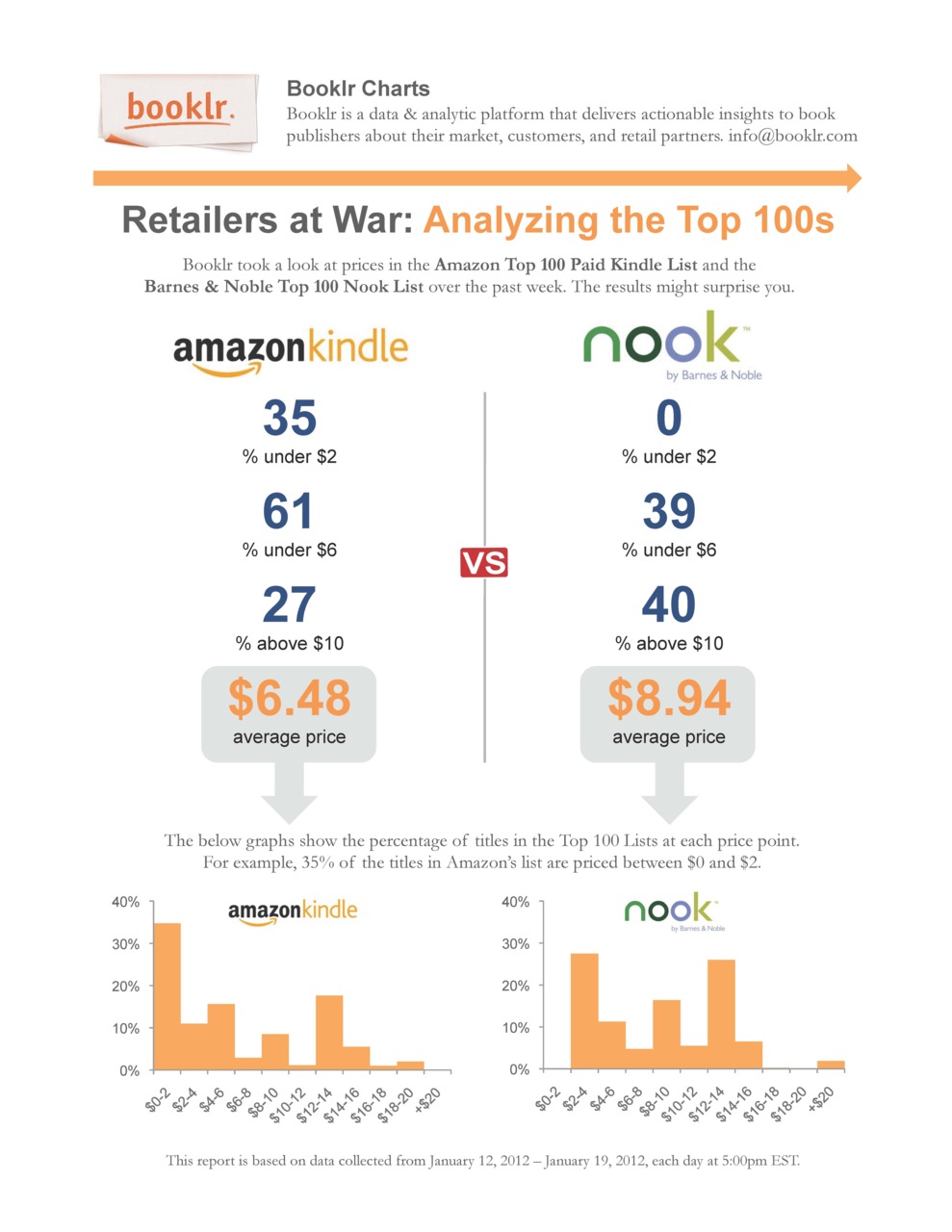
Booklr just released an interesting comparison between the prices of the top 100 sold ebooks on BN.com and Amazon. It's an interesting comparison, although it might have reached the wrong conclusion.

"With the Kindle Fire, Nook, and e-readers constantly in the news, Booklr took a look at the prices in the Amazon Top 100 Kindle List and the Barnes & Noble Top 100 Nook List over the past week. The results might surprise you. The price of ebooks from each retailer is not always uniform. Consumers should consider this important factor since once you choose a device, you’re locked in to that retailer."

As you can see from the comparison below, the average price of a book on the top 100 list on Amazon is $6.48, while the average price of an ebook on the top 100 list on BN.com is $8.94. As you can also see from the comparison below the main reason for the difference is that cheap ebooks, with a cost between $0-2, are 35 percent of the top list on Amazon.

What we can learn from this data?
1. Readers like cheap ebooks.
2. Amazon offers many cheap books.

What we can't learn from this data?
1. ebooks have different prices on Amazon and BN.com - it might be the case, but you can't learn it from this compassion.
2. Amazon is cheaper than B&N - to reach this conclusion, you need to compare apples to apples (the same books), not apples and oranges.


Yours,
Raz @ Eco-Libris

Eco-Libris: Plant a tree for every book you read!

Thursday, January 5, 2012

5 reasons why the Nook spin off gets B&N closer to bankruptcy

Barnes & Noble announced this morning it is beginning “strategic exploratory work” to separate its rapidly growing Nook digital business. If you follow our blog, you're probably not that surprised - as we reported again and again on the B&N Bankruptcy Index series, B&N behaves for a long time like the Nook is its core business and not its 703 bookstore.

So you're probably wondering - would this spin-off will help B&N to avoid bankruptcy? Actually, I believe it only gets them closer to this unfortunate faith. Here's five reasons why:

1. B&N bookstore business is declining and B&N has no clear strategy how to transform it back from a liability to an asset. Frankly, this announcement only demonstrates that B&N is giving up on the brick and mortar stores and putting all its energy and resources just into the Nook. Don't believe me? Just count look how many times B&N mentions its bookstores in its press release from today (hint: less than one).

2. B&N is focusing all of its resources on one egg - the Nook. It's a good egg, but even if it will have a bright future as B&N is expecting it's still too risky, especially in a market where your competitors are are Amazon and Apple.

3. B&N doesn't have the deep pockets Apple and Amazon have. Just look at the balance sheets of these three and compare how much cash each of them has - Amazon has $2.8 billion, Apple has $9.8 billion, while B&N has $23 million in cash and cash equivalents (latest figures available). Now, who do you think has a better chance to develop better tablets and e-readers in the near future?

4. Bad management - B&N would have a much better chance if it would have spun off its management instead of the Nook. Why it's a bad management? How else you can call a management that takes an asset like 700+ bookstores and makes almost zero efforts to save it from bankruptcy?

5. "Mr. Lynch said Barnes & Noble doesn't see itself as a competitor with Apple, as it focuses more on digital reading, but said internal research shows customers prefer the Nook over the Kindle." (Wall Street Journal) I wish I have a faith in a company that this is the worldview that directs its strategy and this is the quality of research data it uses. Unfortunately I really can't.

To learn more on our B&N index series visit Barnes and Noble Bankruptcy Index on our website.

You can find more resources on the future of bookstores on our website at www.ecolibris.net/bookstores_future.asp

Yours,
Raz @ Eco-Libris

Eco-Libris: Working to green the book industry!


Tuesday, December 13, 2011

How investors can profit in the event Barnes & Noble file for bankruptcy

We are watching Barnes & Noble for sometime, discussing the possibility of bankruptcy, which after the one Borders went through seems less illusory.

If you looked at their latest financial results which were released two weeks ago you could see that bankruptcy is still an option, given the fact that B&N has no viable strategy for its brick and mortar bookstores and put all its efforts into the Nook. We believe that this is a risky strategy considering that B&N competes with Apple and Amazon, which have much deeper pockets and probably better devices to start with.

We're not the only ones who identified the risk of bankruptcy. Motley Fool analysts Austin Smith and Nick Crow also see this risk and they have an interesting video where they discuss how investors can protect themselves from such an event and even profit from it. You can find their video here.

To view the weekly changes in the index visit Barnes and Noble Bankruptcy Index on our website.

You can find more resources on the future of bookstores on our website at www.ecolibris.net/bookstores_future.asp

Yours,
Raz @ Eco-Libris

Eco-Libris: Working to green the book industry!

Friday, October 7, 2011

How green is the Kindle Fire - part 4: Can the new tablet actually benefit independent bookstores?

Today we continue with our Amazon week. After discussing if the new Kindle Fire and other new Kindles will contribute to making e-reading greener (it will), and comparing Kindle Fire with iPad 2 and Nook Color and see which device is greener (iPad 2), and it's influence on B&N (big trouble for the bookseller), we'll talk today about the impact of the new Kindle products on independent bookstores.

The good news is that indie bookstores are not invested in any tablet or e-reader like B&N, so they don't have to worry about dwindling sales of electronic products. At the same time, it's quite obvious that the launch of the Kindle Fire will only help increasing ebook sales. This is not good news for independent bookstores because ebook selling is still not one of their strengths and I don't believe it will be in the near future.

Yet, the fact that B&N is in deep trouble because of the new Kindle products offsets this negative impact on indies and in a way creates a positive one. Why? Because my guestimation is that B&N will have to put even more money on their line of Nooks and spend less and less money on their brick and mortar stores, while keep closing a growing number of them to reduce their loses.

So, for indies it means less competition when it comes to book purchasing in bookstores. It doesn't mean a rosy future and we will probably see also indie bookstores that are getting closed, but it might help them to keep their head above the water at least for the near future.

What about the long-term? That's a good question, and the answer mainly relies on the ability of indies to adopt to the 21st century challenges and to change their business model in a way that will meet tomorrow's challenges instead of yesterday's challenges. As
Oren Teicher, CEO of American Booksellers Association wrote lately:

"The fact of the matter is that, for the most part, as an industry we have continued to operate using a business model that has gone largely unchanged in 60 years. While we still very much want to read and handsell our favorite titles from the past, clearly, we no longer have the luxury to continue employing business models that no longer meet the challenges of a radically different social, technological, and business environment. "

Tomorrow we'll have the final piece on our Amazon week, this time on
the influence of the new Kindle Fire on Amazon's carbon footprint and if we'll see any change in the company's refusal to disclose it.

To read more news and updates on the future of bookstores go to our website at http://www.ecolibris.net/bookstores_future.asp

To read more on how green is the Kindle, visit our website at http://www.ecolibris.net/kindle.asp

Yours,
Raz @ Eco-Libris

Eco-Libris: Plant a tree for every book you read!

Thursday, October 6, 2011

How green is the Kindle Fire - part 3: Will it kill B&N and drive the bookseller into bankruptcy?

Today we continue with our Amazon week. After discussing if the new Kindle Fire and other new Kindles will contribute to making e-reading greener (it will), and comparing Kindle Fire with iPad 2 and Nook Color and see which device is greener (iPad 2), we'll talk today about the impact of the new Kindle products on Barnes & Noble.

First, the bottom line: B&N is in trouble. Now let's see why.

Fortune Tech wrote it very clearly: "
While Barnes & Noble has made a valiant effort to keep up with the times with its innovative line of Nook e-readers, it simply can't compete with the likes of Amazon, which introduced its potentially category-killing Kindle Fire last week."

The digital activity of B&N, led by its Nook, was what saved it so far from the same faith of Borders (i.e. bankruptcy) and the focus of its future strategy. In other words, this is what B&N counts on to survive and thrive in the digital age, when brick and mortar stores are no longer cash cows.

And now with the introduction of the new Kindle Fire and the new Kindle products the competition is becoming much harder. Just look at the comparison we provided yesterday between the iPad 2, Kindle Fire and Nook Color. Why would anyone pay now $249 for Nook Color, when they can get the same if not better (updated operating system and so on) Kindle Fire for only $199?

If B&N wants to make Nook Color attractive again they have to reduce its price to at least $199, which means smaller margins for them, which means trouble.

And let's not forget Amazon also announced three more Kindles at the lower end that are priced below B&N's comparable Nooks, which again means trouble for B&N.

What about new B&N products? According to International Business Times, "BN has reportedly been moving toward launching its own new tablet, reportedly called "Acclaim." Reports have suggested the product will be priced at $349. But since Amazon has more content, including streaming movies with its Prime subscriptions, it isn't likely that a higher priced tablet will have much of a chance competing against Amazon's lower-priced tablet. So not only will BN have to slash prices on its Nook products, including the Nook Color, but the company may have already lost on the Acclaim before the public has really even heard about the product."

So, as you can see B&N has to come with an answer to Amazon and do it quickly. The question is if they have an answer and also whether they can afford it. Unfortunately I'm not sure both answers are yes, which means that B&N is indeed in trouble.

To read more of our analysis on B&N visit Barnes and Noble Bankruptcy Index on our website.

To read more on how green is the Kindle, visit our website at
http://www.ecolibris.net/kindle.asp

More resources on the ebooks vs. paper books environmental debate can be found on our website at http://www.ecolibris.net/ebooks.asp.


Yours,

Raz @ Eco-Libris

Eco-Libris: Plant a tree for every book you read!

Tuesday, October 4, 2011

How green is the Kindle Fire? Amazon week - Part 2: Comparing Kindle Fire, iPad 2 and Nook Color

Yesterday we started our Amazon week to examine some of the impacts of the new Kindle Fire and other new Kindle products. Today we'll try to compare compare Kindle Fire with iPad 2 and Nook Color and see which device is greener.

First, we need to acknowledge the sad fact that currently only Apple publishes information on the carbon footprint of its device, as well as information on its eco-friendly features, such as having an
arsenic-free display glass, being brominated flame retardant-free, PVC-free, and so on.

Unlike Apple, Barnes & Noble and Amazon either don't care about the environmental impacts of their devices or just don't think it worth the effort of sharing this information with their customers. Either way, Apple's leadership makes iPad 2 the greener device among the three. Once Amazon and Barnes & Noble will change their mind we could make a meaningful comparison among the three tablets. Until then, Apple's iPad 2 rules!

By the way, if you look at the features comparison between the three below, published by OSXDaily, you will see that the Kindle Fire is lighter than the other two (although it's thicker than the iPad 2), so it will be interesting to see if it also means it is
more material efficient than the Nook Color and the iPad 2. Well, Bezos, we're waiting..


Tomorrow we will see what will be the impact of the new Kindle products on Barnes & Noble.


To read more on how green is your (and my) Kindle, visit our website at http://www.ecolibris.net/kindle.asp

More resources on the ebooks vs. paper books environmental debate can be found on our website at http://www.ecolibris.net/ebooks.asp.


Yours,
Raz @ Eco-Libris

Eco-Libris: Plant a tree for every book you read!

Thursday, September 29, 2011

Come on Bezos, Kindle My Fire, or: Amazon's week on our blog

Jeff Bezos introduced on Wednesday Amazon’s new Kindle Fire tablet device. The new $199 tablet , as well as Amazon's other new products, the all-new Kindle for only $79, two new touch Kindles – Kindle Touch and Kindle Touch 3G – for $99 and $149, are the biggest development in the e-reader /tablet market since the launch of iPad last year and created an incredible buzz.

We also think this is big news and we will have an Amazon week next week, exploring the impacts of the new products in five posts from our green perspective:

On Monday we'll discuss if the new Kindles will contribute to making e-reading greener.

On Tuesday we'll compare Kindle Fire with iPad 2 and Nook Color and see which device is greener.

On Wednesday we'll see what will be the impact of the new Kindle products on Barnes & Noble.

On Thursday we'll check what will be the impact of the new Kindle products on independent bookstores.

Finally, on Friday, we'll discuss the influence of the new Kindle Fire on Amazon's carbon footprint and if we'll see any change in the company's refusal to disclose it.

See below Jeff Bezos demonstrating the new tablet at a presentation on Wednesday:


So stay tuned and visit us next week to learn more on the green impacts of Amazon's new tablet.

Yours,
Raz @ Eco-Libris

Eco-Libris: Plant a tree for every book you read!

Monday, September 12, 2011

Is Books-A-Million going to follow Borders into bankruptcy?

Last month it was announced that Books-A-Million agreed to acquire lease interest in 14 of Borders stores for $934,209. Yet last week GalleyCat reported that Books-A-Million will close four outlets. Add to it 11 percent decrease in sales in the last quarter and you start wondering not only if Books-A-Million made the right decision buying Borders' stores, but also if they're actually able to stay in business or will follow Borders into bankruptcy.

I looked into it and found five signs that Books-A-Million, now the second-largest bookseller might be heading into trouble:

1. Sales are shrinking - Last month the company reported on its second quarter results:  

"Net sales for the 13-week period ended July 30, 2011 decreased 11.4% to $106.4 million from net sales of $120.0 million in the year-earlier period. Comparable store sales for the second quarter declined 12.9% compared with the 13-week period in the prior year. Net loss for the second quarter was $2.9 million, or $0.18 per diluted share, compared with net income of $1.9 million, or $0.12 per diluted share, in the year-earlier period.

For the 26-week period ended July 30, 2011, net sales decreased 11.2% to $210.4 million from net sales of $237.0 million in the year-earlier period. Comparable store sales declined 13.1% compared with the same period in the prior year." 

Why? Commenting on the results, Clyde B. Anderson, Chairman, President and Chief Executive Officer, said, "Results for the quarter reflect a continuation of the trends that have been affecting our business since the beginning of the year. A soft publishing lineup, the effect of e-book migration and the impact of Border's liquidation all contributed to the decline in comparable store sales. In this environment we have been focused on further developing the growth categories in our stores in preparation for the second half of the year while our balance sheet remains strong."

What are exactly the "growth categories" they focus on further developing? It's not clear. Somehow I find this explanation as well as action plan not very reassuring to say the least.

2. Cash reserves are down by almost 40% - Although CEO Anderson said "balance sheet remains strong", you see that cash is down by 38% compared to the end of January 2011. The company has now only 4.8 million in cash and almost 95% of its assets are in its inventory ($192.3 million out of total current assets of $203.7 million) - again, not very relaxing given the fast changes the book business is experiencing. 

3. The stock market does not believe in Books-A-Million - If you had $300 on January 1, 2011 and decided to invest $100 in Amazon, $100 in Barnes and Noble and $100 in Books--Million, your investments would generate you the following return as of yesterday:


1/3/2011 9/9/2011    Return
Amazon 184.22 211.39 14.75%
B&N 15.42 11.38 -26.20%
Books-A-Million 5.86 2.6 -55.63%

The company in its latest annual report explains that "recent market volatility has exerted downward pressure on our stock price, which may make it more difficult for us to raise additional capital in the future."

4. No clear strategy for the brick and mortar stores - Books-A-Million presently operates 232 stores in 23 states and the District of Columbia. Just like with B&N it's not clear what's company's strategy to transform these stores back into an asset. The vast majority of the company's revenues come from bookstores and therefore lack of clear strategy is creating a risk and puts in question the company's ability to increase its sales.

5. No e-reader - Just like Borders, Books-A-Million didn't develop an e-reader of its own and sells B&N's Nook. It means the company is more limited in growing its digital sales and is very much depended on B&N and their success to keep developing the Nook. Bottom line: Books-A-Million does not have the same digital cushion B&N has.

I hope I'm wrong, but Books-A-Million seems to be vulnerable now. If they won't be able to find the right strategy for their brick and mortar business they can be very soon in the same position  Borders found itself not too long ago.

Yours,
Raz @ Eco-Libris

Eco-Libris: Plant trees for your books!

Tuesday, August 30, 2011

Five signs Barnes and Noble is heading for bankruptcy following its latest quarterly report

Barnes & Noble released today its results for the last quarter, ending July 30, 2011. Although B&N's price went up almost 15% following the release of the quarterly report, I see in this report many signs that worry me, as they indicate the company is on its way to bankruptcy, just like Borders.

Here are the most prominent signs:


1. B&N doesn't have a strategy to transform its brick and mortar bookstores from a liability back into an asset and as a result sales continue to decline - "Revenue in stores open at least one year, a key indicator of a retailer's health, fell 1.6% at regular stores and 1.8% at college bookstores."
(Reuters).

2. The Nook itself won't save the company - "
Sales of the Nook group of devices, which includes a standalone as well as a touch-screen reader, rose 140 percent to $277 million in the quarter..Barnes & Noble Inc forecast sales of its Nook e-reader and e-books would more than double this fiscal year to $1.8 billion".

According to
Reuters, "if the Nook and the e-books sales it generates live up to Barnes & Noble's expectations, they would account for a quarter of the chain's sales and all of its growth." Not only that putting all the bets only on the Nook is a risky move, but even if it will succeed the company still have 75% of business in trouble. The Nook itself just won't save the company, no matter how well it will perform.

3. B&N seems to think only about the short term, ignoring the long-term - "Barnes & Noble says it expects to get a lift in sales of $150 million to $200 million after Borders, which declared bankruptcy in February and said it would liquidate in July, completes liquidation sales and closes."We're convinced this holiday will be the biggest traffic we've had in the stores over five years," Lynch said in a call with analysts." (
USATODAY.com) - What will happen after this holiday season and after some Borders' customers will switch to B&N? Lynch has no answer.

4. The stores become a burden on BN.com - "revenue from the website rose 37%, driven by sales of Barnes & Noble's Nook Color and Nook Simple Touch Reader, and digital content." (
USATODAY.com). The success of BN.com only demonstrates the weakness of B&N's brick and mortrar stores, which are still the core business of B&N.

5.
When toys are your best idea to promote sales in stores you're in trouble - "While traditional physical book sales declined during the quarter, the stores posted large increases in sales of the NOOK product line and Toys & Games." Yet, the stores to remind you are still losing, which means that increasing toys sales do not compensate for declining books sales in the stores. Next idea, please.

And finally, did I mention that there is no buyer to the company? If the picture is so rosy as CEO Lynch presents it, how come no one wants to buy the company and enjoy the fruits of the we-invest-only-in-the-Nook strategy? Maybe it's not as brilliant strategy as B&N wants us to believe?


You can check our updates on
Barnes and Noble Bankruptcy Index on our website.

You can also find more resources on the future of bookstores on our website at www.ecolibris.net/bookstores_future.asp

Yours,
Raz @ Eco-Libris

Eco-Libris: Plant a tree for every book you buy!

Saturday, August 20, 2011

Why John Malone does not want to buy Barnes and Noble?

Bloomberg reported yesterday that "Liberty Media Corp., controlled by billionaire John Malone, invested $204 million in Barnes & Noble Inc. (BKS) after dropping its offer to acquire the largest U.S. bookstore chain"

So why did Malone decide not to buy B&N and purchase only 17 percent of the company's stock (at $17 a share)? Here are few possible answers:

1. He finally understood that B&N has become a risky business operating in a volatile environment.

2. He understands that B&N is still mostly a brick and mortar retailer and as such is very vulnerable to the changes in the book industry, from the rise of e-books to increasing competition from discount retailers such as Wal-Mart (Just a reminder: Comparable store sales at its consumer bookstores fell last quarter 2.9% amid a decline in trade books).

3. He knows that B&N has no winning strategy on how to transform its 700+ stores from a liability into an asset. Apparently he doesn't know it either.

4. He learned the lessons from Borders' bankruptcy and liquidation.

5. All replies are correct.

So why does Malone invest $200 million at B&N? I guess he believes this way he is limiting his risks this way and gives himself a ticket to the world of digital reading, tablets and other future gadgets that will take control of our life in the near future.

On Bloomberg, Bill Kavaler, a New York-based analyst at Oscar Gruss & Son Inc., is quoted saying:

“John Malone likes to buy low-cost calls on interesting potential and ideas and Barnes & Noble is interesting as the only national book chain that’s standing,” Kavaler said. “For $200 million, he’s got a shot at seeing what happens.”

Well, I am not sure if this $200 investment is a cheap bargain. We'll have to see about it. As of today, Friday's stock price of $9.98 results in a $80 million paper loss for Malone.

In any event, there's no doubt this is still a very risky investment - not only because of the stores, but also because on the digital side of the business B&N competes with companies that are more technological oriented and have deeper pockets, such as Amazon and Apple.

We hope Malone won't regret it. We'll keep updating you on it.

You can check our updates on Barnes and Noble Bankruptcy Index on our website.

You can also find more resources on the future of bookstores on our website at www.ecolibris.net/bookstores_future.asp

Yours,
Raz @ Eco-Libris

Eco-Libris: Plant a tree for every book you buy!

Wednesday, July 20, 2011

RIP Borders - The bookstore chain is closing its doors

Now it's official - Borders Group announced on Monday that it will close all of its stores and sell the company to a group of liquidators led by Hilco Merchant Resources. It means that almost 11,000 employees will lose their jobs and the chain's 400 remaining stores will close their doors by the end of September.

This is a very sad day to any book lover, no matter if you're a Borders customer or not. The fact is that this isn't just an isolated case, but an indicator to the change in the industry, where brick and mortar stores can't find an adequate reply to the online competition as well as to the growing demand for ebooks and are losing customers until they can no longer stay in business.

NPR report explained the problem:

"Indeed, outside a Borders bookstore in Arlington, Va., shoppers say they rarely buy books the old-fashioned way."I'll go to Borders to find a book, and then I'll to go to Amazon to buy it, generally," customer Jennifer Geier says. With so many people going online to buy books, Borders lost out. The last time it turned a profit was 2006. "

According to NPR the case of B&N is different, but we believe it's actually no different than Borders, at least in the sense that B&N hasn't find yet the way to transform its brick and mortar stores back into an asset. If they won't find the way to do it, they will be left with BN.com and the Nook, but without stores. They still have time to figure it out, but they need to remember their time is running.

Borders stores will begin closing as early as Friday. The New Yorker gives a good advice to spend your gift cards this week. (Please buy books, rather than calendars, lattes, or Moleskine notebooks.) It adds that liquidation will continue through the summer and is likely to be complete by September.

For more news and updates on Borders post bankruptcy visit our website at http://www.ecolibris.net/borders.asp.

You can also find more resources on the future of bookstores on our website at www.ecolibris.net/bookstores_future.asp


Yours,
Raz@Eco-Libris

Eco-Libris: Planting trees for your books

Wednesday, June 22, 2011

Barnes & Noble Bankruptcy Index: Will John Malone still be interested in B&N following their 4Q loss?

After a break of couple of weeks, we're back with our B&N bankruptcy index, following the release yesterday of B&N's fourth quarter report.

Jeffrey Trachtenberg summed B&N's report on the WSJ: "Barnes & Noble Inc., the target of a takeover bid by Liberty Media Corp., saw its digital strategy pay off in its fiscal fourth quarter with healthy gains on the e-book and e-reader front, but investments in that business took a toll on the bottom line."

Still no word about the future of B&N's brick and mortar stores as B&N seems to be putting everything it got on the Nook and e-book sales, a risky bet that might be too risky for a brick and mortar company
. Bottom line: This week our B&N bankruptcy index stays in the 50-59 zone: Bankruptcy is a clear and present danger.

J
ust a short reminder - As Borders filed for bankruptcy couple of months ago, we started looking at Barnes & Noble, the nation's largest book chain to see if they will follow Borders and also go into bankruptcy and if so, when exactly.

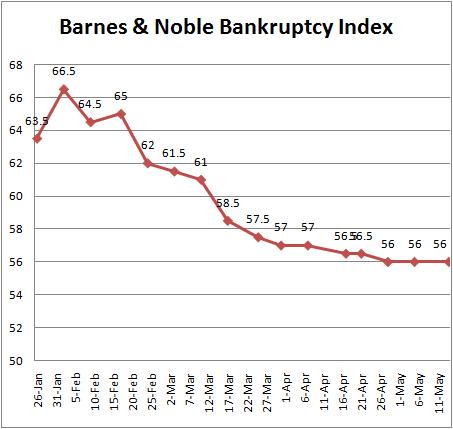
To do it more analytically we launched few weeks ago a new B&N Bankruptcy Index, which is based on 10 parameters, which receive a grade between 1-10 (1 - worst grade, 10 - best grade). Hence we receive a 0-100 point index scale, which we divide into several ranges as follows:

90-100: B&N is in an excellent shape. Couldn't be better!


80-89: B&N is doing great. Bankruptcy is no longer a real threat.


70-79: B&N could do better and has to be cautious of bankruptcy.

60-69: B&N doesn't look too good and bankruptcy is becoming a more realistic threat.


50-59: Bankruptcy is a clear and present danger.


49 and less: Red alert! Bankruptcy is just around the corner and is likely to happen within a short time frame.


We will check the
B&N Bankruptcy Index every Thursday, updating each one of the parameters included in the index and will analyze the trend. You can follow the weekly changes in the index from the day it was launched on the Barnes and Noble Bankruptcy Index page on our website.
So here's our update for this week (in brackets is last week's grade):

1. Confidence of the stock market in B&N
This parameter will look at the performan
ce of the B&N stock (symbol: BKS) in the last week. The performance of B&N's stock is an indication of the confidence the market has in the ability of B&N to maintain a viable business.

So let's look at last week's figures (for consistency we look at results from Wed. 6/15 to Tue. 6/21):

6/15: $19.90
6/21: $18.94
Change: -4.82%


As you can see, B&N's stock lost 4.82%
last week. Just for comparison, Amazon gained 4.44% last week and the S&P500 Index went up 2.38%.

B&N's stock did well in the last couple of weeks and only fell sharply (about 6%) yesterday following the release of the 4Q report. We'll have to see how the market will digest this report and react to the relatively negative comments from analysts following the report.

This wee's grade is staying the same: 5 (5)

2. What analysts say on B&N
"Although store revenue fell, revenue from other sectors rose. Online revenue rose 54 percent to $217.3 million and college bookstore revenue rose 4 percent to $211.2 million.The revenue results show the diverging trends in book retail -- physical store sales fell while online sales rose. But the two aren't as separate as they may appear, said Simba Information senior trade analyst Michael Norris. "The physical stores are the cyclists shielding the team leader from the wind," he said. "There's no way on this planet that bn.com would have grown as much as it did without the bookstores performing as Nook showrooms for the past year." (Yahoo! Finance)

"The bookseller, which suspended its dividend this year to conserve cash, has been using its profits to invest in e-books and its Nook digital reading devices as sales of paper books falter. That helped attract interest from John Malone’s Liberty Media, which offered $17 a share for the bookseller last month. “They’re spending a huge amount of money developing a reader that people are afraid is going to go the way of the VHS tape or the CD,” Bill Kavaler, an analyst at Oscar Gruss & Son Inc. in New York, said in an interview. Kavaler recommends investors sell the shares." (Bloomberg)

"The company has had to ramp up spending on marketing on product development to stay competitive with Amazon.com Inc. (AMZN), whose Kindle is the top selling e-reader, according to Michael Souers, an analyst for Standard & Poor’s in New York. The Nook is “the only driver of long-term growth and they have to establish that niche,” said Souers, who recommends holding Barnes & Noble shares." (Bloomberg)

The market sentiment looks negative after the release of the fourth quarter report - analysts don't like the fact that B&N put all its eggs in the competitive e-book basket. Therefore our grade goes down by half a point: 5 (5.5)

3. New strategy to regain sales in the brick and mortar stores
Just like Borders, B&N still doesn't have yet a clear and comprehensive strategy that will transform their brick and mortar stores from a liability back to an asset. This is also one the reasons their stores keep losing money - Sales at Barnes & Noble stores open at least one year fell by 2.9 percent in the fourth quarter, ended April 30.

Right now all they have is selling more toys and games - CEO Lynch predicted toys and games will become "a very sizeable business for us within a reasonably short time horizon." This doesn't seem to be a very viable strategy to me, as

For all of those at B&N and outside the company who think the brick and mortar stores don't matter so much, especially now when Liberty’s chairman, John Malone has indicated that his primary interest in Barnes & Noble is its Nook e-reader, I'd like to quote again here Michael Norris, an analyst of Simba Information, who said following yesterday's report:

"The physical stores are the cyclists shielding the team leader from the wind," he said. "There's no way on this planet that bn.com would have grown as much as it did without the bookstores performing as Nook showrooms for the past year." (Yahoo! Finance)

This week's grade stays the same: 3.5 (3.5)


4. What B&N is saying about itself
Barnes & Noble said yesterday it is reviewing Liberty Media’s offer, the first bid disclosed publicly since the company put itself up for sale in August. B&N said that while the offer is being considered, earnings projections for fiscal 2012 won’t be announced.

This week's grade stays the same: 6 (6)

5. Steps B&N is taking
No new steps were reported on the report. Apparently B&N won't do anything significant until it will be sold to John Malone if the bid will proceed as planned, even after the release of the 4Q results.

This week's grade stays the same:
6 (6)

6. Competitors
According to Yahoo! Finance, B&N said yesterday results were hurt by Borders' liquidation sales at 200 of its stores. Longer term, however, Barnes & Noble expects to benefit from the store closings. CFO Joseph Lombardi said in areas where a Borders store has closed, nearby Barnes & Nobles are recording revenue increases in stores open at least one year.

Also, it is reported there that
"analysts have speculated over the possibility of some combination of Borders and Barnes & Noble as the industry consolidates. But Lombardi dispelled that idea. He said in a statement that over the past 5 years, before Borders filed for bankruptcy court protection, Barnes & Noble considered buying it "many times" but always came to the conclusion it wasn't interested. "We are still not interested," he said."

This week's grade stays the same:
5 (5)

7. Financial strength

Barnes & Noble released its fourth quarter report yesterday, and as the NYT wrote, it wasn’t pretty. "The company lost $59 million in the quarter, or $1.04 a share. Analysts on average had expected a smaller loss of 91 cents a share. Despite a rise in revenue, thanks to higher online and digital sales, Barnes & Noble was hurt by the liquidation of more than 200 Borders stores as part of that retailer’s bankruptcy. Sales at Barnes & Noble stores open at least one year fell by 2.9 percent in the quarter."

If you compare the results to last year's results, it doesn't look any better - B&N's net loss was $59.4 million, or $1.04 per share, for the three months ended April 30, 2011. A year ago B&N reported a net loss of $32 million, or 58 cents per share for the three months ended April 30, 2010.

This is not a good news from a financial strength perspective and therefore our grade goes does by half a point: 6 (6.5)

8. Strength of the digital business

Although store revenue fell in the fourth quarter, online revenue rose 54 percent to $217.3 million. CEO William Lynch said B&N estimates e-books added 1%-2% to its U.S. market share, bring its total to 26%-27%.

Barnes & Noble also said in its report that its Nook sales continued to improve. The company introduced a new $139 Nook last month in an effort to boost its share of the growing e-book market and also offers a NookColor for $249.

This week's grade goes up by half a point
: 8.5 (8)

9. Sense of urgency
It looks like B&N still think they have time and are not worried at all, especially after they received a proposal from Liberty Media to acquire the company. They might be right because after John Malone will buy the company he's the one who will need to handle these problems. Yet, the purchase hasn't been completed yet and even if Malone will purchase the company, I'm sure it is the best interest of B&N to ensure the company reaches its next phase of operations in the best condition possible.

This week's grade stays the same: 5.5 (5.5)

10. General feeling
This parameter will be an indication of our impression of all the materials read and analyzed for this index. Our feeling that things are still not looking too good for B&N even with the offer they have from Malone - their current strategy of putting all their bets on the digital front is very risky given the fact B&N is still mainly a brick and mortar company. Yesterday's report presents this risk and its results very clearly.

This week's grade for this parameter stays the same
: 5 (5)

This week's Barnes & Noble Bankruptcy Index: 55.5 points (56)

As you can see, this week's index is set at 55.5 points, which means B&N is getting deeper into the 50-59 zone: Bankruptcy is a clear and present danger. It's still not the red zone but it means that bankruptcy is getting closer and is becoming a real threat to B&N. See you next Thursday.

To view the weekly changes in the index visit Barnes and Noble Bankruptcy Index on our website.

You can find more resources on the future of bookstores on our website at www.ecolibris.net/bookstores_future.asp

Yours,
Raz @ Eco-Libris

Eco-Libris: Working to green the book industry!

Friday, May 20, 2011

5 questions to John Malone who is looking to buy Barnes & Noble for $1 billion in cash

Yesterday B&N announced that "the Special Committee of its Board of Directors has received a proposal from Liberty Media to acquire the Company at a price of $17 per share in cash." It means that John Malone, the billionaire who controls Liberty Media is ready to pay about $1 billion in cash to buy B&N.

This is big news and we need some time to digest them and therefore this week we won't have our regular B&N Bankruptcy Index, but instead we'll be asking Malone 5 questions and hopefully we'll be able to receive some answers this week (not directly I assume) and better assess this news for next week's update of the bankruptcy index.

So here are our questions for Mr. Malone:

1. Did you have the chance to talk to Bill Ackman?
He's also a successful businessman and investor who controls Pershing Square Capital Management. Like you he had a good reputation with successful acquisitions in the past that made him money ( Target Stores, J.C. Penney and Fortune Brands) and was looking to achieve similar results with Borders. Four years ago, according to the WSJ, "Ackman first started buying Borders stock, those shares would have been worth $233 million. Today, his stake has lost 99% of its value, down to $2.4 million." Again, he lost about 99% of his investment in Borders.

No wonder Ackman told Deal Journal "it wasn’t a good investment."

2. Do you have a strategy for the brick and mortar bookstores?
No matter how many of them you plan to close and how strongly you want to shift towards the digital business - you're still buying a brick and mortar company (705 stores with 18.4 million square feet, not including B&N college stores) and you need a strategy to start transforming the stores you'll be keeping open back to an asset. Right now, B&N doesn't really seem to have a strategy, so hopefully you bring one with you.

3. Did you watch this video?


It's just 30 seconds, but it will give you an idea you on how complicated and competitive the business environment of B&N is getting.

4. Did you hear about Bookish?
Yes, publishers are becoming your competitors and they're getting better at it. Just read this piece out of Geek.com:

Carolyn Reidy, president and chief executive of Simon & Schuster, told the New York Times that the current discovery of books in the “physical environment” needs to be recreated so that it can happen online, something which Reidy said isn’t currently happening. The NYT said that the publishing companies envision that Bookish will be for books what Pitchfork.com is for music in terms of reviews and information. Bookish, unlike Pitchfork, will also have a sales aspect to it. The site will sell both physical and digital books.

As you can see, there's another front to worry about, so I hope you're ready for that.

5. Did you read the news yesterday that Kindle ebooks outselling print books?
Good news? Yes, you're also in the business of selling e-books and it means it's a growing business. Bad news? You bet.

According to MNN "
The Kindle ebooks began outselling hardcover books on Amazon.com in July 2010. Six months later, Kindle ebooks overtook paperback sales as well.Now, Amazon said it is selling more ebooks than hardcover and paperback books — combined. The trend does not appear to be slowing down any time soon." It only shows you that the ebook revolution is moving fast, very fast.

It means that your clock is ticking and you have very little time to adjust B&N to this digital revolution. Remember, you will have 18.4 million square feet of retail to take care of, while your biggest competitor Amazon has none.

To view the weekly changes in the index visit Barnes and Noble Bankruptcy Index on our website.

You can find more resources on the future of bookstores on our website at www.ecolibris.net/bookstores_future.asp


Yours,
Raz @ Eco-Libris

Eco-Libris: Promoting sustainable reading!

Saturday, May 14, 2011

Barnes & Noble Bankruptcy Index: Borders may have a buyer while B&N put all their eggs in one e-nest

Sorry for the two day delay, but we're here with the weekly update on the B&N bankruptcy index. This week the stock continues to go up, probably still because of B&N's plans to introduce a new e-reader later on this month.

Still no word about the future of B&N's brick and mortar stores as B&N seems to be putting everything it got on the Nook and e-book sales, a risky bet that might be too risky for a brick and mortar company
. Bottom line: This week our B&N bankruptcy index stays in the 50-59 zone: Bankruptcy is a clear and present danger.

J
ust a short reminder - As Borders filed for bankruptcy couple of months ago, we started looking at Barnes & Noble, the nation's largest book chain to see if they will follow Borders and also go into bankruptcy and if so, when exactly.

To do it more analytically we launched few weeks ago a new B&N Bankruptcy Index, which is based on 10 parameters, which receive a grade between 1-10 (1 - worst grade, 10 - best grade). Hence we receive a 0-100 point index scale, which we divide into several ranges as follows:

90-100: B&N is in an excellent shape. Couldn't be better!


80-89: B&N is doing great. Bankruptcy is no longer a real threat.


70-79: B&N could do better and has to be cautious of bankruptcy.

60-69: B&N doesn't look too good and bankruptcy is becoming a more realistic threat.


50-59: Bankruptcy is a clear and present danger.


49 and less: Red alert! Bankruptcy is just around the corner and is likely to happen within a short time frame.


We will check the
B&N Bankruptcy Index every Thursday, updating each one of the parameters included in the index and will analyze the trend. You can follow the weekly changes in the index from the day it was launched on the Barnes and Noble Bankruptcy Index page on our website.
So here's our update for this week (in brackets is last week's grade):

1. Confidence of the stock market in B&N
This parameter will look at the performan
ce of the B&N stock (symbol: BKS) in the last week. The performance of B&N's stock is an indication of the confidence the market has in the ability of B&N to maintain a viable business.

So let's look at last week's figures (for consistency we look at results from Wed. 5/4 to Wed. 5/11):

5/4: $12.01
5/11: $13.46
Change: +12.1%


As you can see, B&N's stock went up in 12.1%
. Just for comparison, Amazon went up 2.2% last week and the S&P500 Index lost 0.4%.

I believe the stock is going up this week because of the same reason it went up last week - the excitement from the news on B&N's upcoming announcement (on May 24) on the launch of a new electronic book reader.

StreetAuthority thinks it's also all about the Nook:

Back in March, I suggested "the odds are increasing for a convincing turnaround." My logic rested on two pillars: First, a massive shrinkage in the store base of rival Border's would help drop-in traffic in those neighborhoods affected. Second, the company's Nook electronic reading device was starting to emerge as a real contender among the small group of e-readers. As it turns out, it's the Nook that explains why shares of Barnes & Noble have taken off like a rocket, rising 50% in less than a month. (Seeking Alpha)

So it looks like the stock jumped only because of the news on the upcoming e-reader, but since this trend is already going on for two weeks and gaining some sort of momentum, this wee's grade is going up in half a point
: 5 (4.5)

2. What analysts say on B&N

Katie Spence still doesn't believe in B&N:

I'm not giving up my books just yet. There is something about the smell and texture of an actual book that simply can't be replicated by e-books. That said, the future of the brick-and-mortar Barnes & Noble looks bleak. With companies such as Amazon dominating in sales, both in e-books and paperback, the time of bookselling superstores is gone. (The Motley Fool)

Spence sees that B&N is putting all her money and efforts into the Nook and ebook sales and she's wondering "are the Nook and e-book sales enough to keep Barnes & Noble afloat?" That's a good question - B&N is taking a very risky gamble here, leaving the stores, which are still its core business, out of the picture.

We don't see a significant change in the market sentiment and therefore our grade stays the same: 5.5 (5.5)

3. New strategy to regain sales in the brick and mortar stores
Just like Borders, B&N still doesn't have yet a clear and comprehensive strategy that will transform their brick and mortar stores from a liability back to an asset.

Still, there's nothing here. Not even a sign of a new strategy. This week's grade stays the same: 3.5 (3.5)

4. What B&N is saying about itself
We didn't find any quotes this week. Our grade for this parameter stays the same: 6 (6)

5. Steps B&N is taking
One interesting step we learned about from the WSJ was B&N's offer to Borders to buy 10 stores, along with the company's website and customer lists. Borders refused to the offer according to the article. This week's grade stays the same: 6 (6)

6. Competitors
This parameter will mainly look in
to Borders and how its problems affect B&N. WSJ reported earlier that "Borders Group Inc. is in discussions with a potential bidder for more than 225 stores that would keep the bookstore chain operating as a going concern, said people familiar with the matter. " Still it's not clear if Borders can find a buyer to the whole business, as according to Bloomberg "No Bidder Said to Be Found to Buy All of Borders." We'll have to wait though and see if it such a deal will actually happen or not and what it will include before we change the grade. Therefore this week's grade stays the same: 5 (5)

7. Financial strength

Katie Spence mentions in a comment she made to her article that "if you look at B&N's long term debt you will notice that it is currently at $260.4 million where as previously it was at 0. Additionally, its total current liabilities exceeds it total current assets and that is with a change in its annual reporting date (usually a bad sign for any company). All in all, the signs are looking bad for the brick-and-mortar company."

This is not a good news from a financial strength perspective and therefore our grade goes does by half a point: 6.5 (7)

8. Strength of the digital business

Nothing much happened on this front. This week's grade stays the same: 8 (8)

9. Sense of urgency
It looks like B&N still think they have time and are not worried at all, or at least not worried enough to begin doing something with their brick and mortar stores (again, we don't believe more toys in the stores and extra room for the Nook is a winning strategy). If we can learn something from the Borders' case, it's how fast things go bad when your reach a certain tipping point of financial distress or distrust of your stakeholders (consumers or publishers for example). This week's grade stays the same: 5.5 (5.5)

10. General feeling
This parameter will be an indication of our impression of all the materials read and analyzed for this index. Our feeling that things are still not looking too good for B&N hasn't changed this week and actually we feel that somehow the company is a bit lost when it comes to find how to generate more sales in its brick and mortar stores. This week's grade for this parameter stays the same
: 5 (5)

This week's Barnes & Noble Bankruptcy Index: 56 points (56)

As you can see, this week's index is set at 56 points, which means B&N is getting deeper into the 50-59 zone: Bankruptcy is a clear and present danger. It's still not the red zone but it means that bankruptcy is getting closer and is becoming a real threat to B&N. See you next Thursday.

To view the weekly changes in the index visit Barnes and Noble Bankruptcy Index on our website.

You can find more resources on the future of bookstores on our website at www.ecolibris.net/bookstores_future.asp

Yours,
Raz @ Eco-Libris

Eco-Libris: Working to green the book industry!