Showing posts with label borders. Show all posts

Tuesday, December 13, 2011

How investors can profit in the event Barnes & Noble file for bankruptcy

We are watching Barnes & Noble for sometime, discussing the possibility of bankruptcy, which after the one Borders went through seems less illusory.

If you looked at their latest financial results which were released two weeks ago you could see that bankruptcy is still an option, given the fact that B&N has no viable strategy for its brick and mortar bookstores and put all its efforts into the Nook. We believe that this is a risky strategy considering that B&N competes with Apple and Amazon, which have much deeper pockets and probably better devices to start with.

We're not the only ones who identified the risk of bankruptcy. Motley Fool analysts Austin Smith and Nick Crow also see this risk and they have an interesting video where they discuss how investors can protect themselves from such an event and even profit from it. You can find their video here.

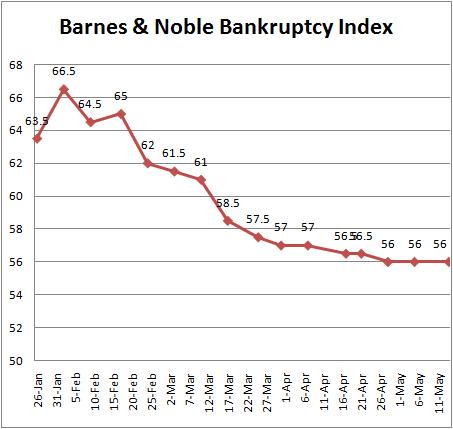
To view the weekly changes in the index visit Barnes and Noble Bankruptcy Index on our website.

You can find more resources on the future of bookstores on our website at www.ecolibris.net/bookstores_future.asp

Yours,
Raz @ Eco-Libris

Eco-Libris: Working to green the book industry!

Sunday, September 18, 2011

Borders was closed today forever, but at least CEO Edwards has got already job offers..

Today is a sad day for book lovers - GalleyCat reported Borders will close forever today, leaving tens of thousands of booksellers out of work. One who is also out of work, but not worried too much about it is Borders' CEO Edwards.

Edwards did an interview to the Detroit News, and according to the newspaper, "he is an unemployed chief executive without a grudge and with a $125,000 severance check.he doesn't know where he's headed — perhaps Southern California or Oregon, where he led Lucy Activewear and Ellington Leather — but he said he has received job offers from companies impressed with his handling of Borders' bankruptcy."

I'm glad to hear that Edwards already has job offers, but I really couldn't understand how any company can be impressed with his handling the bankruptcy. Borders got the worst outcome possible of this bankruptcy, so what's there to be impressed about exactly?

Also another thing that bugged me on this interview is that Edwards doesn't take on himself any responsibility for what happened - "For most of its life, Borders enjoyed a reputation as the go-to destination for bookworms. But "you can be the best ice salesman in America until the refrigerator comes," Edwards said."

That's it? That's the best you can say? How about 'I take responsibility on what happened'? Nothing even close to that.. Well, if this is the sort of leadership the companies offering him job are looking for then they found their right man!

I still think at least his former employees deserve more than that.

Yours,
Raz @Eco-Libris

Eco-Libris: Plant a tree for every book you read

Monday, September 12, 2011

Is Books-A-Million going to follow Borders into bankruptcy?

Last month it was announced that Books-A-Million agreed to acquire lease interest in 14 of Borders stores for $934,209. Yet last week GalleyCat reported that Books-A-Million will close four outlets. Add to it 11 percent decrease in sales in the last quarter and you start wondering not only if Books-A-Million made the right decision buying Borders' stores, but also if they're actually able to stay in business or will follow Borders into bankruptcy.

I looked into it and found five signs that Books-A-Million, now the second-largest bookseller might be heading into trouble:

1. Sales are shrinking - Last month the company reported on its second quarter results:  

"Net sales for the 13-week period ended July 30, 2011 decreased 11.4% to $106.4 million from net sales of $120.0 million in the year-earlier period. Comparable store sales for the second quarter declined 12.9% compared with the 13-week period in the prior year. Net loss for the second quarter was $2.9 million, or $0.18 per diluted share, compared with net income of $1.9 million, or $0.12 per diluted share, in the year-earlier period.

For the 26-week period ended July 30, 2011, net sales decreased 11.2% to $210.4 million from net sales of $237.0 million in the year-earlier period. Comparable store sales declined 13.1% compared with the same period in the prior year." 

Why? Commenting on the results, Clyde B. Anderson, Chairman, President and Chief Executive Officer, said, "Results for the quarter reflect a continuation of the trends that have been affecting our business since the beginning of the year. A soft publishing lineup, the effect of e-book migration and the impact of Border's liquidation all contributed to the decline in comparable store sales. In this environment we have been focused on further developing the growth categories in our stores in preparation for the second half of the year while our balance sheet remains strong."

What are exactly the "growth categories" they focus on further developing? It's not clear. Somehow I find this explanation as well as action plan not very reassuring to say the least.

2. Cash reserves are down by almost 40% - Although CEO Anderson said "balance sheet remains strong", you see that cash is down by 38% compared to the end of January 2011. The company has now only 4.8 million in cash and almost 95% of its assets are in its inventory ($192.3 million out of total current assets of $203.7 million) - again, not very relaxing given the fast changes the book business is experiencing. 

3. The stock market does not believe in Books-A-Million - If you had $300 on January 1, 2011 and decided to invest $100 in Amazon, $100 in Barnes and Noble and $100 in Books--Million, your investments would generate you the following return as of yesterday:


1/3/2011 9/9/2011    Return
Amazon 184.22 211.39 14.75%
B&N 15.42 11.38 -26.20%
Books-A-Million 5.86 2.6 -55.63%

The company in its latest annual report explains that "recent market volatility has exerted downward pressure on our stock price, which may make it more difficult for us to raise additional capital in the future."

4. No clear strategy for the brick and mortar stores - Books-A-Million presently operates 232 stores in 23 states and the District of Columbia. Just like with B&N it's not clear what's company's strategy to transform these stores back into an asset. The vast majority of the company's revenues come from bookstores and therefore lack of clear strategy is creating a risk and puts in question the company's ability to increase its sales.

5. No e-reader - Just like Borders, Books-A-Million didn't develop an e-reader of its own and sells B&N's Nook. It means the company is more limited in growing its digital sales and is very much depended on B&N and their success to keep developing the Nook. Bottom line: Books-A-Million does not have the same digital cushion B&N has.

I hope I'm wrong, but Books-A-Million seems to be vulnerable now. If they won't be able to find the right strategy for their brick and mortar business they can be very soon in the same position  Borders found itself not too long ago.

Yours,
Raz @ Eco-Libris

Eco-Libris: Plant trees for your books!

Tuesday, August 30, 2011

Five signs Barnes and Noble is heading for bankruptcy following its latest quarterly report

Barnes & Noble released today its results for the last quarter, ending July 30, 2011. Although B&N's price went up almost 15% following the release of the quarterly report, I see in this report many signs that worry me, as they indicate the company is on its way to bankruptcy, just like Borders.

Here are the most prominent signs:


1. B&N doesn't have a strategy to transform its brick and mortar bookstores from a liability back into an asset and as a result sales continue to decline - "Revenue in stores open at least one year, a key indicator of a retailer's health, fell 1.6% at regular stores and 1.8% at college bookstores."
(Reuters).

2. The Nook itself won't save the company - "
Sales of the Nook group of devices, which includes a standalone as well as a touch-screen reader, rose 140 percent to $277 million in the quarter..Barnes & Noble Inc forecast sales of its Nook e-reader and e-books would more than double this fiscal year to $1.8 billion".

According to
Reuters, "if the Nook and the e-books sales it generates live up to Barnes & Noble's expectations, they would account for a quarter of the chain's sales and all of its growth." Not only that putting all the bets only on the Nook is a risky move, but even if it will succeed the company still have 75% of business in trouble. The Nook itself just won't save the company, no matter how well it will perform.

3. B&N seems to think only about the short term, ignoring the long-term - "Barnes & Noble says it expects to get a lift in sales of $150 million to $200 million after Borders, which declared bankruptcy in February and said it would liquidate in July, completes liquidation sales and closes."We're convinced this holiday will be the biggest traffic we've had in the stores over five years," Lynch said in a call with analysts." (
USATODAY.com) - What will happen after this holiday season and after some Borders' customers will switch to B&N? Lynch has no answer.

4. The stores become a burden on BN.com - "revenue from the website rose 37%, driven by sales of Barnes & Noble's Nook Color and Nook Simple Touch Reader, and digital content." (
USATODAY.com). The success of BN.com only demonstrates the weakness of B&N's brick and mortrar stores, which are still the core business of B&N.

5.
When toys are your best idea to promote sales in stores you're in trouble - "While traditional physical book sales declined during the quarter, the stores posted large increases in sales of the NOOK product line and Toys & Games." Yet, the stores to remind you are still losing, which means that increasing toys sales do not compensate for declining books sales in the stores. Next idea, please.

And finally, did I mention that there is no buyer to the company? If the picture is so rosy as CEO Lynch presents it, how come no one wants to buy the company and enjoy the fruits of the we-invest-only-in-the-Nook strategy? Maybe it's not as brilliant strategy as B&N wants us to believe?


You can check our updates on
Barnes and Noble Bankruptcy Index on our website.

You can also find more resources on the future of bookstores on our website at www.ecolibris.net/bookstores_future.asp

Yours,
Raz @ Eco-Libris

Eco-Libris: Plant a tree for every book you buy!

Saturday, August 20, 2011

Why John Malone does not want to buy Barnes and Noble?

Bloomberg reported yesterday that "Liberty Media Corp., controlled by billionaire John Malone, invested $204 million in Barnes & Noble Inc. (BKS) after dropping its offer to acquire the largest U.S. bookstore chain"

So why did Malone decide not to buy B&N and purchase only 17 percent of the company's stock (at $17 a share)? Here are few possible answers:

1. He finally understood that B&N has become a risky business operating in a volatile environment.

2. He understands that B&N is still mostly a brick and mortar retailer and as such is very vulnerable to the changes in the book industry, from the rise of e-books to increasing competition from discount retailers such as Wal-Mart (Just a reminder: Comparable store sales at its consumer bookstores fell last quarter 2.9% amid a decline in trade books).

3. He knows that B&N has no winning strategy on how to transform its 700+ stores from a liability into an asset. Apparently he doesn't know it either.

4. He learned the lessons from Borders' bankruptcy and liquidation.

5. All replies are correct.

So why does Malone invest $200 million at B&N? I guess he believes this way he is limiting his risks this way and gives himself a ticket to the world of digital reading, tablets and other future gadgets that will take control of our life in the near future.

On Bloomberg, Bill Kavaler, a New York-based analyst at Oscar Gruss & Son Inc., is quoted saying:

“John Malone likes to buy low-cost calls on interesting potential and ideas and Barnes & Noble is interesting as the only national book chain that’s standing,” Kavaler said. “For $200 million, he’s got a shot at seeing what happens.”

Well, I am not sure if this $200 investment is a cheap bargain. We'll have to see about it. As of today, Friday's stock price of $9.98 results in a $80 million paper loss for Malone.

In any event, there's no doubt this is still a very risky investment - not only because of the stores, but also because on the digital side of the business B&N competes with companies that are more technological oriented and have deeper pockets, such as Amazon and Apple.

We hope Malone won't regret it. We'll keep updating you on it.

You can check our updates on Barnes and Noble Bankruptcy Index on our website.

You can also find more resources on the future of bookstores on our website at www.ecolibris.net/bookstores_future.asp

Yours,
Raz @ Eco-Libris

Eco-Libris: Plant a tree for every book you buy!

Wednesday, July 20, 2011

RIP Borders - The bookstore chain is closing its doors

Now it's official - Borders Group announced on Monday that it will close all of its stores and sell the company to a group of liquidators led by Hilco Merchant Resources. It means that almost 11,000 employees will lose their jobs and the chain's 400 remaining stores will close their doors by the end of September.

This is a very sad day to any book lover, no matter if you're a Borders customer or not. The fact is that this isn't just an isolated case, but an indicator to the change in the industry, where brick and mortar stores can't find an adequate reply to the online competition as well as to the growing demand for ebooks and are losing customers until they can no longer stay in business.

NPR report explained the problem:

"Indeed, outside a Borders bookstore in Arlington, Va., shoppers say they rarely buy books the old-fashioned way."I'll go to Borders to find a book, and then I'll to go to Amazon to buy it, generally," customer Jennifer Geier says. With so many people going online to buy books, Borders lost out. The last time it turned a profit was 2006. "

According to NPR the case of B&N is different, but we believe it's actually no different than Borders, at least in the sense that B&N hasn't find yet the way to transform its brick and mortar stores back into an asset. If they won't find the way to do it, they will be left with BN.com and the Nook, but without stores. They still have time to figure it out, but they need to remember their time is running.

Borders stores will begin closing as early as Friday. The New Yorker gives a good advice to spend your gift cards this week. (Please buy books, rather than calendars, lattes, or Moleskine notebooks.) It adds that liquidation will continue through the summer and is likely to be complete by September.

For more news and updates on Borders post bankruptcy visit our website at http://www.ecolibris.net/borders.asp.

You can also find more resources on the future of bookstores on our website at www.ecolibris.net/bookstores_future.asp


Yours,
Raz@Eco-Libris

Eco-Libris: Planting trees for your books

Sunday, July 17, 2011

Borders is moving towards liquidation - is this the end for the bookstore chain?

Today is an important day for Borders. According to Boston.com, a US bankruptcy court in New York has given Borders today as a deadline to find another bid or its assets will be sold at auction on Tuesday. In other words, the company might be moving towards liquidation which might be the end of for it as a book retailer unless some sort of miracle will happen today.

You can find more details on the latest development on Bloomberg's report (Borders to Seek Court Approval for Liquidators’ Bid Over Offer From Najafi) and the WSJ video report below.


We'll keep you posted with further developments and bring you further analysis later on this week.

For more news and updates on Borders post bankruptcy visit our website at http://www.ecolibris.net/borders.asp.

You can also find more resources on the future of bookstores on our website at www.ecolibris.net/bookstores_future.asp


Yours,
Raz@Eco-Libris
Eco-Libris: Planting trees for your books

Tuesday, July 5, 2011

Is the purchase of Borders by Direct Brands good news for the employees of the book retailer?

It depends who you're asking. According to the Economist (Goodbye to bricks and mortar) it doesn't look too good:

"Whatever happens at the auction will dictate the fate of the bookseller, which has already closed more than a third of its stores. Because Direct Brands is an online- and catalogue-based distributor of music, DVDs and books (such as the mail-order Book of the Month club), some speculate that a deal with Najafi will do little to keep the remaining bookstores open. Rather, the company will probably see value in the Borders distribution network and liquidate most everything else. Regardless, the story doesn’t look good for store employees and their dwindling patrons. (The company, which employs more than 11,000 people, has racked up more than $191m in losses since seeking bankruptcy protection in February, according to the Wall Street Journal.)"

What do you think? We'll be happy to read your comments.

For more news and updates on Borders post bankruptcy visit our website at http://www.ecolibris.net/borders.asp.

You can also find more resources on the future of bookstores on our website at www.ecolibris.net/bookstores_future.asp


Yours,
Raz@Eco-Libris

Eco-Libris: Planting trees for your books

Friday, July 1, 2011

Finally there's a buyer for Borders - Direct Brands of Najafi will buy Borders for $215 million!

Update from Borders: IB Times reported today that Direct Brands, a portfolio company of Najafi, will purchase Borders' assets for $215.1 million (in addition to assuming roughly $220 worth of liabilities).

According to the article on IB Times Borders agreed to the deal, a "stalking horse bid," after considering two offers, and the Ann Arbor, Mich.-based company plans to seek approval from the bankruptcy court.

So who's the buyer? MarketWatch reported that Direct Brands includes Book-of-the-Month Club, Doubleday Book Clubs, Columbia House DVD and BMG Music Service. It was bought by Phoenix, Ariz.-based Najafi in 2008.

Chicago Tribune wrote that a bankruptcy court hearing on the deal is set for July 21. If the court does not approve an auction process, Borders filed a separate motion to liquidate.

What does this purchase mean for the future of Borders and the future of bookstores in general? We'll keep you posted once more information on the deal will be disclosed so stay tuned.

Yours,
Raz @ Eco-Libris

Eco-Libris: Planting trees for your books!

Tuesday, June 21, 2011

Is Nick Sherry right about the death of bookstores within five years?

Nick Sherry, the Australian minister for small businesses started an uproar after predicting that "in five years, other than a few speciality bookshops in capital cities, you will not see a bookstore. They will cease to exist because of what's happening with internet-based, web-based distribution."

His comments, as the Guardian reported, followed the collapse of Australia's largest bookseller, Angus & Robertson, and Australian high street chain Borders earlier this year. Still, Sherry got many book lovers and bookstore owners angry, but is there a chance he might be right, and as much as we hate to hear it, this is the future we're heading to?

I write here extensively about the challenges of brick and mortar bookstores and about the fact that both large retailers (B&N, Borders) and indies haven't found yet the right strategy to bring customers back to the stores. So you might guess I wasn't surprised to hear Sherry's remark. Still I was curious to see what arguments were made against his prediction as I thought they might be a good indicator whether he has a point or not.

So let's look at some of the arguments made against Sherry's prediction:

1. Joel Becker, chief executive of the Australian Booksellers Association, said he was "gobsmacked" at the "extraordinarily unhelpful" remarks, and had written to the minister asking him to explain himself. "It's an industry that's obviously going through changes, and we're responding to those changes by working out ways for even the smallest bookstores to go online and sell ebooks; we've been doing it so far without any support from the government," he told the Sydney Morning Herald.

2. Jon Page, president of the ABA and a bookseller at Sydney's Pages and Pages, insisted on Twitter that "we are not a dead or dying industry". There is "still a place for an independent that services their local community", said Page, telling the SMH that Sherry had shown "a distinct lack of understanding about the Australian book industry".

3. Daniel Jordan, managing director of Collins Booksellers, also dismissed the comment, stating: “To assume that bricks-and-mortar retailing won’t exist in five years is just plain wrong.”

4. Shadow Small Business Minister Bruce Billson also slammed Sherry’s comment, describing the minister as a “prophet of doom”. “Senator Sherry’s defeatist and demoralising commentary adds insult to the injury of his lack of support for retailing as small business adapts and innovates to respond to market trends and difficult trading conditions,” Billson said in a statement.

5. Page has had the same response in his Mosman store, and says it started in February when RedGroup Retail, the parent company of Borders and Angus and Robertson, called in administrators. ''Ever since the collapse of the RedGroup, customers have been coming into my bookshop asking if I am going to close, too,'' he told me yesterday. ''The minister's comments have been very damaging because they have reinforced in some customers' minds the idea that bookshops are on the way out.''

My impression from all these arguments and comments is that they don't really challenge Sherry's assumptions. They don't show in any way how the future of bookstores can be different from the one Sherry predicts and how bookstores can fight back online stores and be relevant to e-book consumers. His prediction might be unpleasant and even wrong in terms of timeframe, but it still important to be aware of this possibility, especially given the fact that we see so many bookstores closing and as we see from Borders' case, even the large retailers are not immune.

Bottom line: Let's not shoot the messenger. It won't help the future of bookstores even a bit.

Yours,
Raz @ Eco-Libris

Eco-Libris: Planting trees for your books!

Friday, May 20, 2011

5 questions to John Malone who is looking to buy Barnes & Noble for $1 billion in cash

Yesterday B&N announced that "the Special Committee of its Board of Directors has received a proposal from Liberty Media to acquire the Company at a price of $17 per share in cash." It means that John Malone, the billionaire who controls Liberty Media is ready to pay about $1 billion in cash to buy B&N.

This is big news and we need some time to digest them and therefore this week we won't have our regular B&N Bankruptcy Index, but instead we'll be asking Malone 5 questions and hopefully we'll be able to receive some answers this week (not directly I assume) and better assess this news for next week's update of the bankruptcy index.

So here are our questions for Mr. Malone:

1. Did you have the chance to talk to Bill Ackman?
He's also a successful businessman and investor who controls Pershing Square Capital Management. Like you he had a good reputation with successful acquisitions in the past that made him money ( Target Stores, J.C. Penney and Fortune Brands) and was looking to achieve similar results with Borders. Four years ago, according to the WSJ, "Ackman first started buying Borders stock, those shares would have been worth $233 million. Today, his stake has lost 99% of its value, down to $2.4 million." Again, he lost about 99% of his investment in Borders.

No wonder Ackman told Deal Journal "it wasn’t a good investment."

2. Do you have a strategy for the brick and mortar bookstores?
No matter how many of them you plan to close and how strongly you want to shift towards the digital business - you're still buying a brick and mortar company (705 stores with 18.4 million square feet, not including B&N college stores) and you need a strategy to start transforming the stores you'll be keeping open back to an asset. Right now, B&N doesn't really seem to have a strategy, so hopefully you bring one with you.

3. Did you watch this video?


It's just 30 seconds, but it will give you an idea you on how complicated and competitive the business environment of B&N is getting.

4. Did you hear about Bookish?
Yes, publishers are becoming your competitors and they're getting better at it. Just read this piece out of Geek.com:

Carolyn Reidy, president and chief executive of Simon & Schuster, told the New York Times that the current discovery of books in the “physical environment” needs to be recreated so that it can happen online, something which Reidy said isn’t currently happening. The NYT said that the publishing companies envision that Bookish will be for books what Pitchfork.com is for music in terms of reviews and information. Bookish, unlike Pitchfork, will also have a sales aspect to it. The site will sell both physical and digital books.

As you can see, there's another front to worry about, so I hope you're ready for that.

5. Did you read the news yesterday that Kindle ebooks outselling print books?
Good news? Yes, you're also in the business of selling e-books and it means it's a growing business. Bad news? You bet.

According to MNN "
The Kindle ebooks began outselling hardcover books on Amazon.com in July 2010. Six months later, Kindle ebooks overtook paperback sales as well.Now, Amazon said it is selling more ebooks than hardcover and paperback books — combined. The trend does not appear to be slowing down any time soon." It only shows you that the ebook revolution is moving fast, very fast.

It means that your clock is ticking and you have very little time to adjust B&N to this digital revolution. Remember, you will have 18.4 million square feet of retail to take care of, while your biggest competitor Amazon has none.

To view the weekly changes in the index visit Barnes and Noble Bankruptcy Index on our website.

You can find more resources on the future of bookstores on our website at www.ecolibris.net/bookstores_future.asp


Yours,
Raz @ Eco-Libris

Eco-Libris: Promoting sustainable reading!

Saturday, May 14, 2011

Barnes & Noble Bankruptcy Index: Borders may have a buyer while B&N put all their eggs in one e-nest

Sorry for the two day delay, but we're here with the weekly update on the B&N bankruptcy index. This week the stock continues to go up, probably still because of B&N's plans to introduce a new e-reader later on this month.

Still no word about the future of B&N's brick and mortar stores as B&N seems to be putting everything it got on the Nook and e-book sales, a risky bet that might be too risky for a brick and mortar company
. Bottom line: This week our B&N bankruptcy index stays in the 50-59 zone: Bankruptcy is a clear and present danger.

J
ust a short reminder - As Borders filed for bankruptcy couple of months ago, we started looking at Barnes & Noble, the nation's largest book chain to see if they will follow Borders and also go into bankruptcy and if so, when exactly.

To do it more analytically we launched few weeks ago a new B&N Bankruptcy Index, which is based on 10 parameters, which receive a grade between 1-10 (1 - worst grade, 10 - best grade). Hence we receive a 0-100 point index scale, which we divide into several ranges as follows:

90-100: B&N is in an excellent shape. Couldn't be better!


80-89: B&N is doing great. Bankruptcy is no longer a real threat.


70-79: B&N could do better and has to be cautious of bankruptcy.

60-69: B&N doesn't look too good and bankruptcy is becoming a more realistic threat.


50-59: Bankruptcy is a clear and present danger.


49 and less: Red alert! Bankruptcy is just around the corner and is likely to happen within a short time frame.


We will check the
B&N Bankruptcy Index every Thursday, updating each one of the parameters included in the index and will analyze the trend. You can follow the weekly changes in the index from the day it was launched on the Barnes and Noble Bankruptcy Index page on our website.
So here's our update for this week (in brackets is last week's grade):

1. Confidence of the stock market in B&N
This parameter will look at the performan
ce of the B&N stock (symbol: BKS) in the last week. The performance of B&N's stock is an indication of the confidence the market has in the ability of B&N to maintain a viable business.

So let's look at last week's figures (for consistency we look at results from Wed. 5/4 to Wed. 5/11):

5/4: $12.01
5/11: $13.46
Change: +12.1%


As you can see, B&N's stock went up in 12.1%
. Just for comparison, Amazon went up 2.2% last week and the S&P500 Index lost 0.4%.

I believe the stock is going up this week because of the same reason it went up last week - the excitement from the news on B&N's upcoming announcement (on May 24) on the launch of a new electronic book reader.

StreetAuthority thinks it's also all about the Nook:

Back in March, I suggested "the odds are increasing for a convincing turnaround." My logic rested on two pillars: First, a massive shrinkage in the store base of rival Border's would help drop-in traffic in those neighborhoods affected. Second, the company's Nook electronic reading device was starting to emerge as a real contender among the small group of e-readers. As it turns out, it's the Nook that explains why shares of Barnes & Noble have taken off like a rocket, rising 50% in less than a month. (Seeking Alpha)

So it looks like the stock jumped only because of the news on the upcoming e-reader, but since this trend is already going on for two weeks and gaining some sort of momentum, this wee's grade is going up in half a point
: 5 (4.5)

2. What analysts say on B&N

Katie Spence still doesn't believe in B&N:

I'm not giving up my books just yet. There is something about the smell and texture of an actual book that simply can't be replicated by e-books. That said, the future of the brick-and-mortar Barnes & Noble looks bleak. With companies such as Amazon dominating in sales, both in e-books and paperback, the time of bookselling superstores is gone. (The Motley Fool)

Spence sees that B&N is putting all her money and efforts into the Nook and ebook sales and she's wondering "are the Nook and e-book sales enough to keep Barnes & Noble afloat?" That's a good question - B&N is taking a very risky gamble here, leaving the stores, which are still its core business, out of the picture.

We don't see a significant change in the market sentiment and therefore our grade stays the same: 5.5 (5.5)

3. New strategy to regain sales in the brick and mortar stores
Just like Borders, B&N still doesn't have yet a clear and comprehensive strategy that will transform their brick and mortar stores from a liability back to an asset.

Still, there's nothing here. Not even a sign of a new strategy. This week's grade stays the same: 3.5 (3.5)

4. What B&N is saying about itself
We didn't find any quotes this week. Our grade for this parameter stays the same: 6 (6)

5. Steps B&N is taking
One interesting step we learned about from the WSJ was B&N's offer to Borders to buy 10 stores, along with the company's website and customer lists. Borders refused to the offer according to the article. This week's grade stays the same: 6 (6)

6. Competitors
This parameter will mainly look in
to Borders and how its problems affect B&N. WSJ reported earlier that "Borders Group Inc. is in discussions with a potential bidder for more than 225 stores that would keep the bookstore chain operating as a going concern, said people familiar with the matter. " Still it's not clear if Borders can find a buyer to the whole business, as according to Bloomberg "No Bidder Said to Be Found to Buy All of Borders." We'll have to wait though and see if it such a deal will actually happen or not and what it will include before we change the grade. Therefore this week's grade stays the same: 5 (5)

7. Financial strength

Katie Spence mentions in a comment she made to her article that "if you look at B&N's long term debt you will notice that it is currently at $260.4 million where as previously it was at 0. Additionally, its total current liabilities exceeds it total current assets and that is with a change in its annual reporting date (usually a bad sign for any company). All in all, the signs are looking bad for the brick-and-mortar company."

This is not a good news from a financial strength perspective and therefore our grade goes does by half a point: 6.5 (7)

8. Strength of the digital business

Nothing much happened on this front. This week's grade stays the same: 8 (8)

9. Sense of urgency
It looks like B&N still think they have time and are not worried at all, or at least not worried enough to begin doing something with their brick and mortar stores (again, we don't believe more toys in the stores and extra room for the Nook is a winning strategy). If we can learn something from the Borders' case, it's how fast things go bad when your reach a certain tipping point of financial distress or distrust of your stakeholders (consumers or publishers for example). This week's grade stays the same: 5.5 (5.5)

10. General feeling
This parameter will be an indication of our impression of all the materials read and analyzed for this index. Our feeling that things are still not looking too good for B&N hasn't changed this week and actually we feel that somehow the company is a bit lost when it comes to find how to generate more sales in its brick and mortar stores. This week's grade for this parameter stays the same
: 5 (5)

This week's Barnes & Noble Bankruptcy Index: 56 points (56)

As you can see, this week's index is set at 56 points, which means B&N is getting deeper into the 50-59 zone: Bankruptcy is a clear and present danger. It's still not the red zone but it means that bankruptcy is getting closer and is becoming a real threat to B&N. See you next Thursday.

To view the weekly changes in the index visit Barnes and Noble Bankruptcy Index on our website.

You can find more resources on the future of bookstores on our website at www.ecolibris.net/bookstores_future.asp

Yours,
Raz @ Eco-Libris

Eco-Libris: Working to green the book industry!

Thursday, May 5, 2011

Barnes & Noble Bankruptcy Index: B&N has plans for a new e-book reader, but apparently not for the stores

This week was about the the new plan of B&N to introduce a new e-reader later on this month, which might be according to the WSJ "a more powerful combination tablet and e-reader". And what about new design for B&N's stores? Nada, at least for now.

Given that B&N is still mostly a store-based retailer, it's not much of a surprise we're not too impressed with this step (unlike the stock market, where the stock rose in 17%) and this week our B&N bankruptcy index stays the same
.

J
ust a short reminder - As Borders filed for bankruptcy, we look at Barnes & Noble, the nation's largest book chain to see if they will follow Borders and also go into bankruptcy and if so, when exactly.

To do it more analytically we launched few weeks ago a new B&N Bankruptcy Index, which is based on 10 parameters, which receive a grade between 1-10 (1 - worst grade, 10 - best grade). Hence we receive a 0-100 point index scale, which we divide into several ranges as follows:

90-100: B&N is in an excellent shape. Couldn't be better!


80-89: B&N is doing great. Bankruptcy is no longer a real threat.


70-79: B&N could do better and has to be cautious of bankruptcy.


60-69: B&N doesn't look too good and bankruptcy is becoming a more realistic threat.


50-59: Bankruptcy is a clear and present danger.


49 and less: Red alert! Bankruptcy is just around the corner and is likely to happen within a short time frame.


We will check the
B&N Bankruptcy Index every Thursday, updating each one of the parameters included in the index and will analyze the trend. You can follow the weekly changes in the index from the day it was launched on the Barnes and Noble Bankruptcy Index page on our website.
So here's our update for this week (in brackets is last week's grade):

1. Confidence of the stock market in B&N
This parameter will look at the performan
ce of the B&N stock (symbol: BKS) in the last week. The performance of B&N's stock is an indication of the confidence the market has in the ability of B&N to maintain a viable business.

So let's look at last week's figures:

4/27: $9.90
5/4: $12.01
Change: +16.9%


As you can see, B&N's stock rose sharply almost 17% last week
. Just for comparison, Amazon went up 1.7% last week and the S&P500 Index lost 0.6%.

Most of this happened yesterday due to the news that B&N "plans to make an announcement on the launch of a new electronic book reader on May 24th, according to a regulatory filing released after the close of trading on Wednesday." (Reuters, May 4)

Since it looks like the stock jumped only because of this update, it doesn't really represent any significant change and we'll have to see if this rally will continue next week before we'll make any changes in our estimations of this parameter. Therefore, our
week's grade stays the same: 4.5 (4.5)

2. What analysts say on B&N

Arunava De wrote on The Motley Fool:

"It is evident that Barnes & Noble means business when it comes to stabilizing its position in the e-reader market. It is willing to take a fall in net income to get a footing in the battle of book retailers. This aggressive strategy seems to make sense, especially as the physical component of the business becomes less attractive.

In a world where the consumer is on a constant lookout for better shopping and consumption experiences, launching a full frontal attack with better services will probably get results. The only problem here is that with falling earnings, investors are probably going to be apprehensive about B&N’s stock. But if the company can turn the tide, there might just be good profits on the way. But be careful: first, a lot of things have to go right."

We don't see a significant change in the market sentiment and therefore our grade stays the same: 5.5 (5.5)

3. New strategy to regain sales in the brick and mortar stores
Just like Borders, B&N still doesn't have yet a clear and comprehensive strategy that will transform their brick and mortar stores from a liability back to an asset.

Still, nada. B&N plans a new e-reader but doesn't seem to plan any new strategy for its brick and mortar stores, at least that's what we can tell from the information the company makes available. Unfortunately I believe there are no secret plans waiting to be disclosed in the right moment - there are just no plans at the moment.

This week's grade stays the same: 3.5 (3.5)

4. What B&N is saying about itself
We didn't find any quotes this week. Our grade for this parameter stays the same: 6 (6)

5. Steps B&N is taking
Two things happened last week - B&N
announced that "it has entered into an amendment that will extend its existing $1 billion revolving credit agreement on more favorable terms" and also disclosed that it plans to unveil a new electronic book reader later this month. The first step is aimed to enhance the company's financial flexibility and the second one to improve its competitiveness on the digital front.

In all these are positive steps, but we're not sure yet how they'll impact B&N's efforts to get back on the track (again - no step is taken to improve sales at the stores, which are the more vulnerable part in B&N operations at the moment). This week's grade stays the same:
6 (6)

6. Competitors
This parameter will mainly look in
to Borders and how its problems affect B&N. Last Friday, according to Bloomberg, "reported a loss of $24.3 million for the month ended March 26, according to court papers...The current report shows revenue of $165.2 million for the month ended March 26 and total assets of $942.2 million. Cash and equivalents are $80.9 million, the company reported." Our grade stays the same: 5 (5)

7. Financial strength

On February Barnes & Noble published the results for the third quarter
. On Monday B&N announced it "has entered into an amendment that will extend its existing $1 billion revolving credit agreement on more favorable terms. "

Here are more details from their press release:

The amended $1 billion revolving credit facility takes advantage of conditions in the financial markets that are more favorable than when the original facility was established. The amended facility has lower interest costs, greater financial flexibility and increases overall borrowing capacity throughout the year...

“Amending our revolving credit facility enables us to lower our anticipated cost of capital and enhance our financial flexibility as we continue to transform the company and execute our strategic plan,” said Joseph Lombardi, chief financial officer of Barnes & Noble, Inc. “We appreciate the strong level of support we received from our lenders.”

This should be helpful, but we don't find this step too significant overall and therefore our grade stays the same: 7 (7)

8. Strength of the digital business

B&N will unveil a new electronic book reader later this month, according to a regulatory filing released after the close of trading yesterday.

WSJ adds that "One possibility is Barnes & Noble will release a more powerful combination tablet and e-reader, perhaps running a more advanced software like Google Inc.'s Honeycomb software. Honeycomb is a version of the Android operating system Google created specifically for tablets."

This is a positive step and our grade this week goes up in half a point: 8 (7.5)

9. Sense of urgency
It looks like B&N still think they have time and are not worried at all, or at least not worried enough to begin doing something with their brick and mortar stores (again, we don't believe more toys in the stores and extra room for the Nook is a winning strategy). If we can learn something from the Borders' case, it's how fast things go bad when your reach a certain tipping point of financial distress or distrust of your stakeholders (consumers or publishers for example). This week's grade stays the same: 5.5 (5.5)

10. General feeling
This parameter will be an indication of our impression of all the materials read and analyzed for this index. Our feeling that things are still not looking too good for B&N hasn't changed this week and actually we feel that somehow the company is a bit lost when it comes to find how to generate more sales in its brick and mortar stores. Therefore
this parameter's grade goes down by half a point: 5 (5.5)

This week's Barnes & Noble Bankruptcy Index: 56 points (56)

As you can see, this week's index is set at 56 points, which means B&N is getting deeper into the 50-59 zone: Bankruptcy is a clear and present danger. It's still not the red zone but it means that bankruptcy is getting closer and is becoming a real threat to B&N. See you next Thursday.

To view the weekly changes in the index visit Barnes and Noble Bankruptcy Index on our website.

You can find more resources on the future of bookstores on our website at www.ecolibris.net/bookstores_future.asp

Yours,
Raz @ Eco-Libris

Eco-Libris: Working to green the book industry!

Thursday, April 28, 2011

Barnes & Noble Bankruptcy Index: The Nook Color has new features and apps, but what about the stores?

This week was about the the new features B&N introduced to its Nook Color e-reader designed to make the device more competitive with the iPad and other tablets. What about new design for B&N's stores? Nada, at least for now. Given that B&N is still mostly a store-based retailer, it's not much of a surprise this week our B&N bankruptcy index goes down by half a point.

J
ust a short reminder - As Borders filed for bankruptcy, we look at Barnes & Noble, the nation's largest book chain to see if they will follow Borders and also go into bankruptcy and if so, when exactly.

To do it more analytically we launched few weeks ago a new B&N Bankruptcy Index, which is based on 10 parameters, which receive a grade between 1-10 (1 - worst grade, 10 - best grade). Hence we receive a 0-100 point index scale, which we divide into several ranges as follows:

90-100: B&N is in an excellent shape. Couldn't be better!


80-89: B&N is doing great. Bankruptcy is no longer a real threat.


70-79: B&N could do better and has to be cautious of bankruptcy.


60-69: B&N doesn't look too good and bankruptcy is becoming a more realistic threat.


50-59: Bankruptcy is a clear and present danger.


49 and less: Red alert! Bankruptcy is just around the corner and is likely to happen within a short time frame.


We will check the
B&N Bankruptcy Index every Thursday, updating each one of the parameters included in the index and will analyze the trend. You can follow the weekly changes in the index from the day it was launched on the Barnes and Noble Bankruptcy Index page on our website.
So here's our update for this week (in brackets is last week's grade):

1. Confidence of the stock market in B&N
This parameter will look at the performan
ce of the B&N stock (symbol: BKS) in the last week. The performance of B&N's stock is an indication of the confidence the market has in the ability of B&N to maintain a viable business.

So let's look at last week's figures:

4/20: $10.66
4/27: $9.90
Change: -7.1%


As you can see, B&N's stock fell 7.1% last week
. Just for comparison, Amazon lost 0.9% last week and the S&P500 Index gained 1.3%.

Alyce Lomax was unfavorable to say the least about B&N stock on The Motley Fool with headline saying simply -Run From This Stock! And she explains:

Although Barnes & Noble has been able to pull off sales increases over recent years, its gross profit has dropped to 25.6% in the last 12 months, down from highs as great as 37% in recent years. Same-store sales have falle
n several years running, and the company failed to turn a profit last year. For the trailing 12 months, Barnes & Noble has reported a disheartening $0.81 loss per share. The recessionary climate hasn't made things easy for booksellers, and its falling profit margins suggest that Barnes & Noble's had to offer deep discounts to keep customers coming back.

What about the Nook and
the latest improvements? She's not convinced it can really change the big grimy picture: "The rise of e-books to challenge traditional paper tomes makes matters even worse...This heated competition explains Barnes & Noble's Nook Color enhancements, but such admirable efforts don't guarantee marketplace success."

If you listen to
Jim Cramer, he also recommends to be cautious about B&N's stock: The book store chain operator has a great management team, Cramer said. Even so, it's been very tough for them to compete against Amazon.com. He would be cautious with BKS.


As we can see the stock
didn't continue to rise as it did last week (jumping 15.5%), which shows that it was more likely a more of a one-week event and not a permanent trend. Therefore, our week's grade for this parameter is going down by half a point: 4.5 (5)

2. What analysts say on B&N

Alyce Lomax wrote on The Motley Fool:

Granted, Barnes & Noble has more than a few positive attributes. It's enjoyed a decent success with its Nook e-reader, and the company recently added several innovative features to its Nook Color, including an app store and the ability to access Yahoo! Mail and Gmail accounts. It's also reportedly looked into taking over a few abandoned Borders stores for its own shops. Still, while B&N may be doing better than Borders, "relatively strong" isn't the same as "strong."

Still, we don't see a significant change in the market sentiment and therefore o
ur grade stays the same: 5.5 (5.5)

3. New strategy to regain sales in the brick and mortar stores
Just like Borders, B&N still doesn't have yet a clear and comprehensive strategy that will transform their brick and mortar stores from a liability back to an asset.

First, I want to mention something quite revolutionary that will happen at one of B&N bookstores. This is an update from Forbes:

Yesterday, I received this press release from Loud Crow Interactive:

On Monday, May 2, renowned writer and illustrator Sandra Boynton will become the world’s first author to sign an eBook app for the general public. This historic signing will take place at 7:00 PM at Barnes & Noble’s Upper East Side store, located at 150 E 86th Street at Lexington Avenue, in New York City.

Julie Bosman reported on Sunday on the New York Times on an upcoming campaign of B&N: "The first commercial in the campaign will run on Monday, and a longer 60-second spot will run during “American Idol” on Thursday. Print ads will run in The New York Times and USA Today. On the company’s Facebook page, users will be invited to share their feelings about reading."

Why we put it under brick and mortar bookstores' strategy? Because of the following comment we found on the article:

There are no Barnes & Noble stores in the ads, a nod to the transformation that is under way in the publishing industry. As e-books have taken off, foot traffic in brick-and-mortar stores has decreased, a sure sign that more consumers are doing their book-shopping from home. (Or wherever they and their e-readers happen to be at the moment.)

The fact that there are no B&N stores (unlike a campaign from last year, where Last year, "where initial campaign to introduce the Nook Color opened on a picture of a Barnes & Noble store, the camera zooming through the entrance and landing on a Nook Color, while Sarah Jessica Parker narrated the voice-over"), only shows me that while the Nook is on the top of the to-do list of B&N, the stores are at the bottom of the list, if at all.

The fact that B&N work so hard and put their cash into only improving their digital business' positioning while completely ignoring their brick and mortar stores (as we can see clearly in their new ad campaign), is an indication for us they still don't see the launch of a new strategy as a high priority and therefore this week's grade goes down in half a point: 3.5 (4)

4. What B&N is saying about itself
“We really wanted to reach out to all the readers and get the message out about how wonderful reading is. The world changes, technology changes, but people love to read, and we’re giving them the best way to read.” Sasha Norkin, the vice president for digital and channel marketing for BN.com talking on the new ad campaign.

Our grade for this parameter stays the same: 6 (6)

5. Steps B&N is taking It was a relatively busy week with the new improvements in the Nook Color and the upcoming ad campaign. These are good steps, but still insufficient when you look at the big B&N picture and the challenges the company is facing. This week's grade stays the same: 6 (6)

6. Competitors
This parameter will mainly look in
to Borders and how its problems affect B&N. This week Borders, according to Bloomberg, "won approval of an amended executive bonus plan after a judge sought changes to resolve objections from an arm of the U.S. government that oversees bankruptcies. " Our grade stays the same: 5 (5)

7. Financial strength
On February Barnes & Noble published the results for the third quarter. We don't have any updates for this week and our grade stays the same: 7 (7)

8. Strength of the digital business
On Monday B&N announced it "Expands Award-Winning NOOK Color™ Reading Experience with the Most Requested Tablet Features", or in other words (the WSJ's words..) Barnes & Noble Upgrades Nook to Challenge Tablets.

WSJ adds:

The bookseller hopes the software upgrade will make the Nook Color, which has a touchscreen and runs Google Inc.'s Android software, an alternative for consumers who want features like email and games like Rovio's "Angry Birds." Barnes & Noble is also adding the ability to play Adobe Systems Inc.'s Flash video on its Web browser. Priced at $249 apiece, Nook Color is hundreds of dollars less than competitors that include Apple Inc.'s iPad 2, Motorola Mobility Inc.'s Xoom and the Research In Motion Ltd. PlayBook.

And don't forget the Apps! "Users now will be able to purchase and download apps from the Barnes & Noble website, though initially the selection is limited compared with the wider Android store."
Revenues from the Apps? Well, B&N will get 30% of the sale price and the remainder will go to the developer.

The idea was to meet consumers' demand - "Consumers said they wanted tablet-like features," said Jamie Iannone, president of the bookstore chain's digital products division.


Some analysts say it's not Apple Barnes & Noble look at, but Amazon -
"I don't think they're responding to the iPad as much as they're trying to beat Amazon to the same punch," said Forrester Research analyst James McQuivey.

He's also providing interesting data: "McQuivey estimates Barnes & Noble has sold 400,000 Nook Colors since the device's October launch and said the device's sales could reach 3 million units by year-end. The black and white Nook was introduced in late 2009 and has sold about 2 million units, according McQuivey."

Ina Fried adds another interesting angle on AllThingsD about the implications on the B&N-Amazon competition:

In addition to boosting the Nook Color’s attractiveness against the current e-reader and tablet competition, the move to open up to developers could serve the company well if Amazon makes a move to offer an Android tablet of its own, something many expect it to do. Amazon has already opened an Android app store, has music and video services that work on Android and also last week launched a version of its Kindle reader software that is optimized for tablets running the Honeycomb version of Android. Amazon has declined to comment on any tablet plans.

Bottom line, this is a positive step and our grade this week goes up in half a point: 7.5 (7)

9. Sense of urgency
It looks like B&N still think they have time and are not worried at all, or at least not worried enough to begin doing something with their brick and mortar stores (again, we don't believe more toys in the stores and extra room for the Nook is a winning strategy). If we can learn something from the Borders' case, it's how fast things go bad when your reach a certain tipping point of financial distress or distrust of your stakeholders (consumers or publishers for example). This week's grade stays the same: 5.5 (5.5)

10. General feeling
This parameter will be an indication of our impression of all the materials read and analyzed for this index. Our feeling that things are still not looking too good for B&N hasn't changed this week and
this parameter's grade stays the same: 5.5 (5.5)

This week's Barnes & Noble Bankruptcy Index: 56 points (56.5)

As you can see, this week's index is set at 56 points, which means B&N is getting deeper into the 50-59 zone: Bankruptcy is a clear and present danger. It's still not the red zone but it means that bankruptcy is getting closer and is becoming a real threat to B&N. See you next Thursday.

To view the weekly changes in the index visit Barnes and Noble Bankruptcy Index on our website.

You can find more resources on the future of bookstores on our website at www.ecolibris.net/bookstores_future.asp

Yours,
Raz @ Eco-Libris

Eco-Libris: Working to green the book industry!