Wednesday, January 19, 2011

The green book of the week - The Sustainable MBA: The Manager’s Guide to Green Business

The first thought I had in mind when I read "The Sustainable MBA: The Manager’s Guide to Green Business" by Giselle Weybrecht was that I wish this book would have been published 10 years ago when I was an MBA student. Since that can't happen, I can only wish every current MBA student, from those in Harvard to those taking MBA classes online, will get to read it and learn valuable lessons about green business.

As an adjunct professor in the University of Delaware's Alfred Lerner College of Business and Economics, teaching MBA and undergraduate students sustainability and green business, I find this book a great resource to both young and old graduates who are looking to better understand how to integrate sustainability in their organization.Link

This is not just a useful book, but also one that makes you think about the basics of sustainability and how much it makes sense for business in so many levels, creating opportunities, increasing revenues and decreasing costs and risks. If you need a mirror to how unsustainable the current business world is and a guide showing you how exactly you can change it, no matter what area you're operating in, this is your book.

We wanted to learn more about the book and asked the author, Giselle Weybrecht, for an interview. You can read it just after the details on the book and the author.

About the book:

The Sustainable MBA: The Manager’s Guide to Green Business provides the knowledge and tools to help you “green” your job and organization, to turn sustainability talk into action for the benefit of your bottom line and society as a whole.

The Sustainable MBA is organized like a business school course – allowing you easy access to the relevant information you need about sustainability and Accounting, Economics, Entrepreneurship, Ethics, Finance, Marketing, Organizational Behaviour, Operations and Strategy.

Based on more than 100 interviews with experts in business, international organizations, NGOs and universities from around the world, this first of its kind guide brings together all the pieces of the business and sustainability puzzle including;

    ❑ The basics on what sustainability is, why you should be interested, how to get started, and what a sustainable organization looks like.
    ❑ A wide range of tools, guidelines, techniques and concepts that you can use to implement sustainability practices.
    ❑ Tools and tips on how to “green” your job, including how to sell these ideas to your team, how to make green choices as a consumer and how to organize green meetings.
    ❑ A survey of the exciting trends in sustainable business happening around the world.
    ❑ A wealth of links to interesting resources for more information.
To see a full Table of Contents and a sample chapter click here

About the author:

Giselle Weybrecht is the author of ‘The Sustainable MBA: The Manager’s Guide to Green Business’ published by Wiley in 2010 (www.thesustainablemba.com). The book aims to educate the next generation of business leaders about sustainability issues, whether these be students or business executives. Prior to this she worked for many years with the United Nations internationally in sustainable development including with the UN World Water Assessment Programme at UNESCO. She has also worked with government, NGOs, business and with social entrepreneurs around the world in sustainability.

Giselle holds an undergraduate degree from Queens’ University in Canada in political science and development studies and an MBA from London Business School and is a graduate of the Beahrs Environmental Leadership Programme at University of California Berkeley. Today she writes, speaks and does consulting relating to embedding sustainability into business schools and businesses internationally and developing engagement and training programs to ensure that students and employees know what sustainability is all about and how they can be part of making their businesses more sustainable.

And now to the interview with Giselle:


Hello Giselle. What difference do you see between the time when you were MBA student and today when it comes to embedding sustainability in business schools?

My answer to this question really depends on the day you ask it. Some days I feel that things are completely different for these new classes of MBA students. They have access to a greater number of electives, courses, clubs, speaker series, and conferences, all focused on topics related to sustainability. I regularly speak with faculty and deans who are really committed to these issues and embedding them into the curriculum.

There is definitely a growing interest in business schools about these issues. However, there are other days, when I take a closer look at some of these initiatives or speak with the students taking part in these events, that I realize that the majority of MBA students are still graduating with very little knowledge about what sustainability means to business, why it is important and how to implement it. The embedding part is taking a lot longer than I would have liked.

Do you think business schools are moving forward faster or slower than the business world itself when it comes to sustainability?

Business schools are moving much slower than the business world. There are many companies that are really pushing the boundaries when it comes to sustainability. They are exploring what it means to their core business, their customers and their employees. Business schools are increasingly talking about it but few are really taking a serious look at it in the way that businesses are.

Of all the topics you describe in the book (finance, operations, marketing, etc.) - where do you think we see the most progress?

There is a lot of progress being made in all of the areas described in the book, and there is an increasing number of individuals and organizations working on each of the topics covered. Most companies start with the more straightforward subjects; marketing, operations, strategy. Fewer companies have been looking at topics such as accounting, finance and even organizational behavior, but this is changing rapidly.

When I read your book, the business case of sustainability seems very clear - so how come we don't see more companies that adopt these practices? Is it lack of vision, leadership, policy incentives or there's just not enough interest on the consumers side?

As outlined in the book there are several reasons why businesses move forward in this area. The details of exactly why and how vary depending on the business, the industry, the location. It is up to managers and employees to think strategically about what this has to do with their business, their customers, and their employees in particular. Many managers still think sustainability is a feel good topic, that it is about doing the right thing that it is something you can switch on and off. In reality, sustainability is a complex topic and requires a real commitment.

What would you suggest to managers who want to better understand what sustainability is all about and how they can use it at work? Where should they start (or what's the second step after buying your book)?

Regardless of what your job is there are ways for you to start exploring these issues, and potentially make a real impact through your work. In the book there is a chapter called Getting Started to help employees and managers move forward in this area as well as many tips and tools to get you started. I recommend starting with the book to get a good grasp of the issues and what is happening in this area. Then spend a bit of time looking into what is happening both in your business and in your industry with sustainability. Pick the topics that you feel most affect your business or the job that you do and move forward from there.

What would you recommend to students who are looking for an MBA program? How should they take into account the 'green' factor? Should they prefer programs that focus mainly on green issues (like the programs at Presidio Graduate School)?

For students who decide to do an MBA my suggestion is to make sure you get the strongest business education you can. In order to bring sustainability into business and to make a difference in this area, graduates need to have a sound knowledge of business. During the MBA, there are countless ways to learn about sustainability. Look at schools that provide a good balance of the two.

Do you find yourself more or less optimistic today comparing to what you felt when you started working on this book?

I'm a very optimistic person, although I often get frustrated at how slowly progress happens. I have received an incredible response to the book and what the book is trying to do, by businesses, academics and individuals. Things are picking up in this area, it is very exciting.

What are you currently working on? Any new book on the horizon?

I have a lot of new projects happening at the moment, which include a new book, developing innovative workshops for business and university on sustainability, speaking and strategic consulting work. Keep an eye on my website (www.thesustainablemba.com) for more details about these!

Thank you, Giselle! To learn more about the book visit www.thesustainablemba.com. Last but not least, the book is printed on FSC-certified paper. You can buy it on Amazon (it's also available as an ebook).

Yours,

Raz @ Eco-Libris

Eco-Libris: Working to green up the publishing industry!

Monday, January 17, 2011

Reminder: We giveaway a copy of the audiobook 'The Playbook', narrated by Neil Patrick Harris

You can still win a copy of Barney Stinson and Matt Kuhn's audiobook 'The Playbook'. As we wrote here last Wednesday we're giving away a copy of this audiobook, courtesy of the publisher, Simon & Simon audio.

How you can win? Very simple. All you have to do is to add a comment to Wednesday's post with your tip on the best way become a ladies’ man just like Barney Stinson. We will have a raffle on Wednesday, January 19, 5:00PM EST between all the readers that will leave a comment by then. The winner will be announced the following day.

Yours,
Raz @ Eco-Libris

Eco-Libris: Promoting sustainable reading!

Friday, January 14, 2011

The Book Saver offers a new way to digitize your library (if you have the time and patience)

Ion Audio is releasing the Book Saver, an e-reader conversion system for printed materials. According to the company, it's the "fastest and most convenient system for transferring novels, textbooks and periodicals to the digital realm."

As you can see in the video below, Book Saver has two cameras that take separate images in rapid succession of each page within an open book. Book Saver works very fast - it takes only one second per two pages according to the company, which means that to copy a 200-page book will take you about 15 minutes.

The Book Saver, which will be offered in a price of $149, is indeed a great way to digitize your library, but will readers have the time and energy to really use it, when they can digitize almost any book in their library by purchasing and downloading it in no effort and no time?

Let's take for example a beloved book on my shelf - Catch 22 by Joseph Heller. It has 464 pages, which means that using the Book Saver it will take me about 35 minutes to digitize the whole book, if I won't get tired and keep doing it at the same pace. On the other hand, I can go to Amazon Kindle store, pay $12.99 (for some reason the e-book cost more than the paperback..) and have it on my Kindle in one minute. In this case, I would say I would go for the second option and maybe spend an half hour reading it instead of storing it.

What would you do? Do you see yourself using the Book Saver or you rather just digitize your library by downloading it? We'll be happy to hear your thoughts.


Yours,
Raz @ Eco-Libris

Eco-Libris: Promoting sustainable reading!

Thursday, January 13, 2011

Where readers buy their ebooks? Week 6 of our 10-week survey: It's getting messy!

We're on the 6th week of our 10-week ebook experiment. Like all experiments, it began with a question: Where will readers look to buy their ebooks? Following the launch of Google eBookstore, its collaboration with independent bookstores and with Amazon, B&N, Borders and other bookstores fighting on their market share, the competition between ebook retailers is getting fierce.

Our assumption is that many readers will look for e-books using a search engine and will buy from one of the first results of their search. So we randomly chose 10 books of the New York Times’ 100 Notable Books of 2010 and googled each title with the word ebook and wrote down the first two results we got. We redo it every Thursday for 10 weeks and will see if there are any changes in the search results.

Here are the results for week 6. In brackets you'll see the first week results. If they were the same we just wrote 'same'. And if you click on the titles, you will be forwarded to the first place on the title's search):

1. Girl by the Road at Night by David Rabe
1st place: Simon & Schuster (same)
2nd place: Simon & Schuster (same)

2. The Long Song by Andrea Levy
1st place: Amazon.com (same)
2nd place: Amazon.com (same)

3. The New Yorker Stories by Ann Beattie
1st place: Amazon.com (same)
2nd place: Simon & Schuster (Amazon)

4. A Visit from the Goon Squad by Jennifer Egan
1st place: Amazon.com (same)
2nd place: Powell's Books (Random House)

5. Big Girls Don't Cry by Rebecca Traister
1st place: Simon & Schuster (same)
2nd place: Simon & Schuster (same)

6. The Price of Altruism by Oren Harman
1st place: Kobo (same)
2nd place: Amazon.com (same)

7. INSECTOPEDIA by Hugh Raffles
1st place: Amazon.com (same)
2nd place: Amazon (eBooks.com)

8. Country Driving by Peter Hessler
1st place: Goodreads (Barnes & Noble)
2nd place:Barnes & Noble (Amazon)

9. The Warmth of Other Suns by Isabel Wilkerson
1st place: Random House (eBooks.com)
2nd place: eBookMall (Barnes & Noble)

10. Hitch 22 by Christopher Hitchens
1st place: Amazon.com (same)
2nd place: Barnes & Noble (same)

Here's the summary of the results:


Amazon B&N Publishers Others

1st 2nd 1st 2nd 1st 2nd 1st 2nd
week 1 6 3 1 2 3 4 0 1
week2 6 4 1 3 3 3 0 0
week3 6 2 1 2 3 4 0 2
week4 6 3 2 1 2 4 0 2
week5 5 4 1 2 2 3 2 1
week6 5 3 0 2 3 3 2 2


We give 2 points for 1st place and 1 point for 2nd place:


Amazon
B&N
Google
Publishers
Others
week 1
15
4
0
10
1
week 2
16
5
0
9
0
week 3
14
4
0
10
2
week 4
15
5
0
8
2
week 5
14
4
0
7
5
week 6
13
2
0
9
6


S
o what do have here? Amazon lost another point, but is still in the first place, but right now this is not the news. The real is news is that a) B&N is loosing ground with their worst performance so far (just 2 points) and b) we see a growing number of new players joining the game - Powell's Books and eBookMall, which are joining gooreads and kobo, giving the 'Others' segment on the highest number of points so far - 6 points.

Conclusions? Not yet, but it looks like the competition is getting stronger, which means that it might be a field of Amazon and many others, or just multiple number of players without anyone that really dominant the search results. Anyway, it's certainly getting more interesting!
See you next Thursday.

Yours,
Raz @ Eco-Libris

Eco-Libris: Promoting sustainable reading!

Wednesday, January 12, 2011

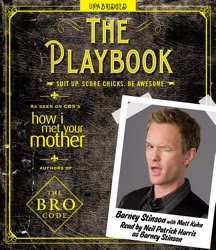
The audiobook of the week: The Playbook by Barney Stinson and Matt Kuhn (and a giveaway!)

The Playbook (or in it's full name - The Playbook: Suit up. Score chicks. Be awesome.) by Barney Stinson and Matt Kuhn is not necessarily just for the fans of 'How I Met Your Mother', but it's definitely a guys' audiobook (I don't know if there's even such a thing, but if there is an audiobook that guys and only guys will enjoy, this is the one).

Well, at least I'm not such a big fan of 'How I Met Your Mother' and I really enjoyed this audiobook. I have to admit though that I've seen couple of episodes, so I know who Barney Stinson is (I had no idea who Matt Kuhn is and later on learned he's a staff writer for the show and helps write
Barney's Blog on the show's website).

Neil Patrick Harris who is reading The Playbook (and plays Barney Stinson in the show if you haven't seen it at all) provides here another example of a great actor that provides a great added-value to this book by reading it and makes it REALLY funny.


I guess not all guys would appreciate 75 ways of how to seduce women, but I believe most of them will, even the ones who are out of the game for a while, who can only be sorry they didn't have access to The Playbook when they were dating, or trying to date women. I really doubt how many of these techniques actually work (SNASA scientist? the Olympian? the Author?), but Patrick Harris sounds so convincing, so who knows..

The bottom line is that this audiobook is a great laugh and also a good lesson in awesomeness and that's all it matters.
I especially recommend it for trips in the car on the way to a bachelor party (I'm thinking on The Hangover for example) or for road trips in general.

You can purchase this audiobook as a CD pack (2 disks) or download it (which we must add is the greener option between the two).


Here's a description of the new audiobook (from the publisher's website):
Since the dawn of history man has searched for the answer to the most fundamental of questions: "Why am I here . . . not banging chicks?" The search is over. Now, with the help of The Playbook, you'll be able to approach any beautiful woman, discover her innermost passion, and use that to trick her into sleeping with you. You'll master more than 75 seduction techniques, developed by pickup guru and all-around good guy Barney Stinson, guaranteed to turn you into a bona fide ladies' man.

Here's an excerpt from the book:


Disclosure: We received a copy of this audiobook from the publisher (Simon and Simon Audio).

GIVEAWAY ALERT!!
We're giving away a copy of this audiobook, courtesy of the publisher, Simon & Simon audio!

How you can win? Very simple. All you have to do is to add a comment with your tip on the best way become a ladies’ man just like Barney Stinson. We will have a raffle on Wednesday, January 19, 5:00PM EST between all the readers that will leave a comment by then. The winner will be announced the following day.

Yours,
Raz @ Eco-Libris

Eco-Libris: Promoting sustainable reading!

Tuesday, January 11, 2011

How green is your (and my) Kindle?

Fact 1: I have a Kindle.

Fact 2: I have no idea what is its carbon footprint.

Fact 3: No one really knows it (well, maybe Amazon does, but they don't tell us, so who knows..)

There was an attempt to figure out the Kindle's footprint in 2009 - Cleantech Group published on August 2009 a report (E-readers a win for carbon emissions) which determined it was "an average of 167.78 kg of CO2 during its lifespan". We looked carefully at the report and wrote here (New report finds Kindle greener than physical books - is that really so?) about our doubts regarding the validity of the findings.We thought that as these results are not based on a life cycle analysis and lack any sort of scientific base they shouldn't be used.

I wouldn't get into it again if I haven't had the chance to see that this figure was presented last December
on ABC'S Good Morning America by Sierra Club Green Home's Jennifer Schwab in a segment of 'Just One Thing' that was about how green e-readers really are. You can see it yourself on the video below and even in the picture below of the video, where there's a sign next to a Kindle saying 'E-reader: 168 kg CO2.


I was surprised to see that Sierra Club Green Home use this figure and therefore I'd like to remind them as well as others who are interested in finding out what the Kindle's footprint is what's wrong with this figure of 168 kg CO2.

Here's what I wrote about it in our analysis here back in September 2009:

"...the second-generation Kindle represents the same emissions as 15 books bought in person or 30 purchased online. That would yield a range of between 60.2 to 306 kg of CO2, or an average of 167.78 kg of CO2 during its lifespan."

The problem is with this estimate (Kindle has the same emissions as 15 books bought in person or 30 purchased online). This is not a figure provided by Amazon. The report is explaining that "Amazon declined to provide information about its manufacturing process or carbon footprint". This report takes this figure from a "Los Angeles-based architecture and construction firm Marmol Radziner Prefab used the IDC lifecycle analysis calculator."

I went on to check how Marmol Radziner Prefab come out with this number if Amazon doesn't provide any data and found on their website that "One of our architects recently gave the calculator a whirl by estimating the carbon footprint of Amazon’s new Kindle Wireless Reading Device. " OK, but how did he do it? they explain: "He answered a few questions and found that the Kindle has the same footprint as 30 paperbacks ordered from Amazon’s store. So if you’re going to read more than 30 books on your Kindle, it’s greener to purchase the digital reader than the paper copies."

Given the fact that Amazon doesn't provide any data (well, we have to say the report mention that Amazon has established a recycling program by mail for Kindle and its batteries to prevent the improper disposal of e-waste), this figure looks to me as a guestimation. In any case, an experimental use of an architect with the IDC lifecycle analysis calculator is far from being something you can take into an account in an analysis, especially when you don't have any second or third sources to verify it.

The person who actually made this investigation in the first place and whom the research refers to added a comment to the post on our blog saying:

"..this was done over the weekend as a (fairly intensive) exploration of the calculator software and should not in any way be interpreted as a scientific study...I am a little bit shocked that Cleantech would appropriate this post without at least asking me about the rigor of my methods, or simply doing a few hours' more research on their own and getting a more accurate result from the calculator themselves. Much more rigor should as well go into the lifecycle study of paperback books, particularly factoring in overproduction and the costs of warehousing and recycling the unsold stock."

So as you can see the figure of 168 kg C02 is far from being scientific-based or anything close it (unlike for example the iPad's footprint of 130 kg CO2 that is provided by Apple and therefore is considered reliable). Therefore, I think Sierra Club and others shouldn't use it and wait until Amazon release their own figure or a reliable life cycle analysis will be conducted to figure it out.

More resources on the ebooks vs. paper books environmental debate can be found on our website at http://www.ecolibris.net/ebooks.asp.


Yours,
Raz @ Eco-Libris

Eco-Libris: Promoting Sustainable Reading!

Monday, January 10, 2011

How the Dodd-Frank Bill will make sure there are no conflict minerals in Apple's iPad?

That's a question I'm asking myself since the Dodd-Frank Bill Wall Street Reform and Consumer Protection Act was signed into law last July, as it included a provision that was specifically addressing conflict minerals from the Democratic Republic of Congo, which might be used in the manufacturing process of the iPad (as well as other e-readers and tablet computers).

The bill, as Laura Heaton explained last July on Change.org, "includes a provision requiring U.S. companies that import products containing certain minerals to file an annual report declaring whether they source their minerals from Congo or one of the nine surrounding countries, since much of Congo’s mineral wealth is smuggled out of the region through its neighbors. If a company declares that its supply chain passes through the region, it will have to report what steps it is taking to trace the origin of the minerals and ensure that its purchases don’t fund armed groups responsible for atrocities in eastern Congo."


I'm still trying to figure out how companies like Apple address the new provision so I was happy to learn that IHS and GreenBiz Group will have a free webcast that about this issue on Janurary 20. Spekaers include Rory King, Director, Global Product Marketing, IHS , Andrew K. Reese, Editor, Supply & Demand Chain Executive, Scott Wilson, Content Solution Strategist, IHS, and it will be moderated by John Davies, VP, Senior Analyst, GreenBiz Group .

Here are some more details on the webcast from its webpage:


Almost overnight, deeply entrenched high tech industry experts and the general public alike, were startled by the inclusion of "conflict minerals" being signed into law within the Dodd-Frank Wall Street Reform and Consumer Protection Act. The six-page legislative provisions signed on July 21, 2010 will have a direct impact on the supply chain, especially consumer electronics companies square in its cross-hairs. Gold, tin, tantalum and tungsten are among materials subject to regulatory requirements that seek to limit or eliminate materials that support parties linked with human rights abuses and funding armed groups in or near the Democratic Republic of the Congo (DRC).

The most immediately affected are publicly traded companies, most notably in the high tech sector, who are subject to pending SEC reporting requirements. However, the question remains: Will a conflict minerals movement sink enough teeth into the supply chain to fundamentally change price, availability and supplier selection for these metals and subsequently blind-side adjacent supply chains and all regions around the globe? Find out.

Join
IHS and GreenBiz Group on this live webcast as they unveil the results of an exclusive survey that gauged awareness, sentiment, concern, and preparedness of the supply chain in response to conflict minerals traceability and accountability. They will share findings from the study and share practitioner insight as to such questions as:
  • What is this Conflict Minerals law and what are the conflict metals?
  • Where are these materials used throughout the supply chain?
  • How prepared are companies and their suppliers to trace this information today?
  • What are the most current global conflict mineral concerns?
  • What are the current best practices in environmental compliance?
You can sign for it here.

You can learn more on conflict minerals on this video:


Yours,
Raz @ Eco-Libris

Eco-Libris: Promoting Sustainable Reading!