Saturday, March 19, 2011

Earth Day Campaign - 41 Reasons to Plant a Tree for Your Book: Reason no. 7

We continue today with our Earth Day campaign - 41 Reasons to Plant a Tree for Your Book, where we share with you 41 reasons provided by readers in celebration of the upcoming 41st anniversary of Earth Day.

With more than 180,000 trees planted so far on behalf of readers, authors and publishers working with Eco-Libris, it's no surprise that we think planting trees to green up books is a great idea.. But we also want to hear what readers think about it and why they believe planting trees for their books is a good idea.

So for 41 days until Earth Day, we publish here the 41 best replies we receive, one reply a day. All replies are gathered and presented on the campaign's page.


Reason no. 7:


Though I believe it's important to not only read but also preserve the real, physical book, I don't believe it's right to fell old growth forests to fill my shelves. Also, as an author, I want people to have the option to read my new book in the form that has served humans well for centuries. That's why I support Eco-Libris. Long live books and forests! - Kelly

Thank you Kelly for sharing with us your thoughts on planting trees for your book!

Kelly, just like all t
he other readers whose replies we'll publish, is winning one of the great 41 prizes we give away on this campaign, courtesy of our partners. Winners can choose their prize from a great list of gifts including audiobooks from Simon & Schuster Audio (such as The Half Life by Jennifer Weiner, American Assassin by Vince Flynn and Essence of Happiness by the Dalai Lama) and great books, like Planet Home by Jeffrey Hollender, Spit That Out! by Paige Wolf, Menu Dating by Tristan Coopersmith and The Healthy Home by Dave Wentz and Dr. Myron Wentz. You can see the full list of the prizes on the campaign's page.

Every day we'll give further details on one of the prizes. Today we present you with the audiobook
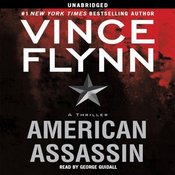
American Assassin by Vince Flynn:

American Assassin by Vince Flynn - #1 New York Times bestseling author Vince Flynn introduces the young Mitch Rapp on his first assignment, a mission of vengeance that made him a CIA superagent— and a terrorist's worst nightmare.

Two decades after the Cold War, CIA Operations Director Thomas Stansfield must prepare his people for the next conflict. The rise of Islamic terrorism is coming, and it needs to be met abroad before it reaches America's shores. Stansfield directs his protÉgÉe, Irene Kennedy, and his old colleague, Stan Hurley, to form a new group of clandestine operatives—men who do not exist—who will work outside the normal chain of command. Kennedy finds the ideal candidate in the wake of the Pan Am Lockerbie bombing terrorist attack. . . .

Among the thousands of family and friends grieving the victims is Mitch Rapp, a gifted college athlete, who wants only one thing: retribution. Six months of intense training prepare him to bring the war to the enemy's doorstep, and he does so with brutal efficiency, leaving a trail of bodies from Istanbul and across Europe, to Beirut. But there, the hunter becomes the hunted: the enemy has prepared a trap, and the American assassin will need every ounce of skill and cunning if he is to survive the warravaged city and its deadly terrorist factions.

If you want to participate in the campaign, we still have some spots available so please send us your reply, either by adding a comment here or sending it to info@ecolibris.net. We look forward to hearing from you.

Yours,
Raz @ Eco-Libris

Eco-Libris: Promoting sustainable reading!

Comparing between the iPad and the iPad 2 from a green perspective

Last week the environmental report of the iPad 2, where we learned that its carbon footprint is 105 kg CO2e, a reduction of 19.2% comparing to the footprint of the first model.

On Tuesday we started to look into the new report and showed what it means in terms of breakeven point with paper books.
Today, in the second part of our analysis, we try to find out what the real "green" differences between the two models of the iPad are.

We'll look at each of the components of the
life cycle analysis that Apple did to determine the carbon footprint of the iPad and the iPad 2 - production, transport, customer use and recycling. We'll also look into other specifications that Apple emphasizes on its report.

Production:

Carbon footprint of the iPad - 75.4 kg CO2e
Carbon footprint of the iPad 2 - 63 kg CO2e

Change: -16.4%


The iPad 2 is thinner and lighter than the original iPad. In terms of materials Apple mentions that "iPad 2 is even more material efficient than the original iPad, consuming up to 18 percent less material. The chart below details the materials used for iPad 2."

Here you can see the materials used for the iPad 2 (source: Apple's report):

And here are the materials used for the first iPad (source: Apple's report)

Here's a comparison of the data presented in these graphs (weight, in grams):


iPad iPad 2 Change
Display 155 140 -9.7%
Plastic 55 17 -69.1%
Other metals 40 25 -37.5%
Circuit boards 45 38 -15.6%
Glass 155 105 -32.3%
Battery 155 130 -16.1%
Aluminum
125 135 8.0%

It's interesting to see that the biggest changes are with the plastic and other metals and also that unlike the other components, the usage of aluminum actually increased in the iPad 2 in 8%. I believe that the efficient use of materials is the main reason for the reduction in the production's footprint. I also believe that this is also a place where Apple actaully saved money while reducing its product's carbon footprint.

Transport:
Carbon footprint of the iPad - 14.3 kg CO2e
Carbon footprint of the iPad 2 - 10.5 kg CO2e

Change: -26.6%


There's no explanation in the report where this reduction is coming from. One option this reduction is due to further efficiency in packaging - iPad 2 retail packaging consumes 51 percent
less material, which allows "up to 38 percent more units to be transported in an airline shipping container compared with the original iPad".

Apple also mentions that"the packaging for iPad 2 is highly recyclable. It uses corrugated cardboard made from a minimum of 28 percent post-consumer recycled content, and molded fiber made entirely from recycled content."

On the report of the first iPad, Apple wrote: "The packaging for iPad is almost entirely recyclable and uses corrugate cardboard made from a minimum of 33 percent post-consumer recycled content. In addition, its packaging is extremely material efficient, allowing more units to be transported in a single shipping container. "

As you can see, the percentage of post-consumer recycled content in the corrugated cardboard actually dropped from 33 to 28, although with the iPad 2, Apple mentions that the molded fiber made entirely from recycled content whereas in the first report it doesn't mention this fiber at all.

Alternatively, maybe Apple started using hybrid trucks?

Customer use
Carbon footprint of the iPad - 39 kg CO2e
Carbon footprint of the iPad 2 - 30.45 kg CO2e

Change: -21.9%


Apple is presenting in the reports information on the energy efficiency usage, which should be the most relevant component to this part:

Energy efficiency in the iPad 2:
iPad 2 uses power-efficient components and software that intelligently manages
power consumption. In addition, the iPad 10W USB Power Adapter outperforms the
stringent requirements of the ENERGY STAR specification for external power supplies.
The following table details the power consumed by iPad 2 in different use modes.

Power Consumption for iPad 2 (Wi-Fi + 3G)
Mode 100V 115V 230V
Sleep 0.46W 0.41W 0.45W
Idle—Display on 3.10W 3.08W 3.16W
Power adapter, no-load 0.07W 0.07W 0.09W
Power adapter efficiency 80.9% 80.8% 79.9%

Energy efficiency in the first iPad:
iPad uses power-efficient components and software that intelligently manages power consumption. In addition, the iPad 10W USB Power Adapter outperforms the stringent requirements of the ENERGY STAR specification for external power supplies. The following table details the power consumed by iPad in different use modes.

Power Consumption for iPad (Wi-Fi + 3G)
Mode 100V 115V 230V
Sleep 0.42W 0.43W 0.41W
Idle—Display on 2.97W 2.96W 3.04W
Power adapter, no-load 0.07W 0.07W 0.09W
Power adapter efficiency 80.9% 80.8% 79.9%

I have to admit that I am not sure yet how this data, showing relatively modest power consumption reductions is translated into a 22% reduction in the carbon footprint of customer use. Did I miss something here?

Recycling:
Carbon footprint of the iPad - 1.3 kg CO2e
Carbon footprint of the iPad 2 - 1.05 kg CO2e

Change: -19.2%


In both cases Apple offers the same description:
Through ultra-efficient design and use of highly recyclable materials, Apple has minimized material waste at the product’s end of life. In addition, Apple offers and participates in various product take-back and recycling programs in 95 percent of the regions where Apple products are sold. All products are processed in the country or region in which they are collected. For more information on how to take advantage of these programs, visit www.apple.com/environment/recycling/.

Strangely, if you go to this webpage, you will find that Apple has no mention of the iPad there, but only computers, displays, iPods and mobile phones. Even if we assume that the iPad has similar recycle offering as the iPod (and I have to say I'm not so sure about it), it's still far from being convenient or attractive - you can either send your old device by mail or bring it to one of Apple's stores and get 10% discount when purchasing a new one. So the bottom line is that Apple, even though it minimize the material waste by using materials more efficiently still doesn't make a real effort to make sure the first model or the second model of the iPad won't end their life eventually in the landfill.

Apple's commitment to the environment:

There's an introduction to the report where Apple is emphasizing its commitment imporving the environmental performance of its products. This part (see below) hasn't changed and the text in the iPad 2 report is identical to the text in the iPad report.


Apple believes that improving the environmental performance of our business starts with our products. The careful environmental management of our products throughout their life cycles includes controlling the quantity and type of materials used in their manufacture, improving their energy efficiency, and designing them for better recyclability.


Restricted substances:

Comparing between the two reports, we find this part identical. In both cases Apple mentions that "
Apple has long taken a leadership role in restricting harmful substances from itsproducts and packaging. As part of this strategy, all Apple products comply with the strict European Directive on the Restriction of the Use of Certain Hazardous Substances in Electrical and Electronic Equipment, also known as the RoHS Directive. Examples of materials restricted by RoHS include lead, mercury, cadmium, hexavalent chromium, and PBB and PBDE brominated flame retardants (BFRs)."

According to the reports, both the iPad and the iPad 2 go even further than the requirements of the RoHS Directive by incorporating the following more aggressive restrictions:
• Mercury-free LED-backlit display
• Arsenic-free display glass
• Brominated flame retardant (BFR)−free
• Polyvinyl chloride (PVC)−free

General green specs:
Apple is providing a summary of the "green" specs in each report under "Environmental Status report". This report is identical for both models and include the following:

• Arsenic-free display glass
• Brominated flame retardant-free
• Mercury-free LED backlit display
• PVC-free
• Recyclable aluminum and glass enclosure
• Power adapter outperforms strictest global energy efficiency standards

And finally, here's a summary of the changes in the carbon footprint of each component:


iPad iPad 2 Change
Production 75.4 63 -16.4%
Transport 14.3 10.5 -26.6%
Customer use 39 30.45 -21.9%
Recycling 1.3 1.05 -19.2%
Carbon footprint: 130 105 -19.2%

More resources on how green is the iPad can be found on our website at www.ecolibris.net/ipad.asp

More resources on the ebooks vs. physical books environmental debate can be found on our website at www.ecolibris.net/ebooks.asp.

Yours,
Raz @ Eco-Libris

Eco-Libris: Promoting sustainable reading!

Friday, March 18, 2011

Earth Day 2011 Campaign - 41 Reasons to Plant a Tree for Your Book: Reason no. 6

We continue today with our Earth Day 2011 campaign - 41 Reasons to Plant a Tree for Your Book, where we share with you 41 reasons provided by readers in celebration of the upcoming 41st anniversary of Earth Day.

With more than 180,000 trees planted so far on behalf of readers, authors and publishers working with Eco-Libris, it's no surprise that we think planting trees to green up books is a great idea.. But we also want to hear what readers think about it and why they believe planting trees for their books is a good idea.

So for 41 days until Earth Day, we publish here the 41 best replies we receive, one reply a day. All replies are gathered and presented on the campaign's page.


Reason no. 6:


Because there's nothing better than relaxing under the shade of a tree while reading your favorite book! - Anne

Thank you Anne for sharing with us your thoughts on planting trees for your book!

Anne, just like all the other readers whose replies we'll publish, is winning one of the great 41 prizes we give away on this campaign,
courtesy of our partners. Winners can choose their prize from a great list of gifts including a $25 gift card for Strand Bookstore, audiobooks from Simon & Schuster Audio (such as The Half Life by Jennifer Weiner, American Assassin by Vince Flynn and Essence of Happiness by the Dalai Lama) and great books, like Planet Home by Jeffrey Hollender, Spit That Out! by Paige Wolf, Menu Dating by Tristan Coopersmith and The Healthy Home by Dave Wentz and Dr. Myron Wentz. You can see the full list of the prizes on the campaign's page.

Every day we'll give further details on one of the prizes. Today we start with the audiobook
The Half Life by Jennifer Weiner:

From Redbook’s Red-Hot Read series, a short story by the New York Times #1 best-selling author of In Her Shoes and Fly Away Home.

"My life is over," Piper DeWitt thinks to herself, awaiting departure in the overcrowded International Terminal of the Philadelphia airport for an overseas business trip, to romantic Paris no less. She watched as her husband, Tosh, put his own suitcase into the trunk of a taxi the day before. He’d been telling her for months that he wasn’t happy, and though she still wants to believe it is just a phase, after a call to her mother from the Admiral’s Club, she can no longer deny that he’s left her, left their home, left their four-year-old daughter in her mother’s sole care.

Piper met Tosh when she was only twenty-two, just the way self help books said she would – when she wasn’t looking. Now at forty, she wonders how, through all those years, they’d gotten to this place in their marriage. When her flight is canceled due to volcanic ash spreading from Iceland across Europe, and when a handsome stranger offers her an invitation to share a cab, she realizes she can take a departure from her own life. And after a day of living like a tourist in her own city, she hopes she can still find her way home…

If you want to participate in the campaign, we still have some spots available so please send us your reply, either by adding a comment here or sending it to info@ecolibris.net. We look forward to hearing from you.

Yours,
Raz @ Eco-Libris

Eco-Libris: Promoting sustainable reading!

Thursday, March 17, 2011

Earth Day 2011 - 41 Reasons to Plant a Tree for Your Book: Reason no. 5

We continue today with our Earth Day 2011 campaign - 41 Reasons to Plant a Tree for Your Book, where we share with you 41 reasons provided by readers in celebration of the upcoming 41st anniversary of Earth Day.

With more than 180,000 trees planted so far on behalf of readers, authors and publishers working with Eco-Libris, it's no surprise that we think planting trees to green up books is a great idea.. But we also want to hear what readers think about it and why they believe planting trees for their books is a good idea.

So for 41 days until Earth Day, we publish here the 41 best replies we receive, one reply a day. All replies are gathered and presented on the campaign's page.


Reason no. 5:


We should plant trees for books because they sacrificed their lives so we could read. Let's repay our debt! - Eric Wilson, co-founder of 2ndgreenrevolution.com

Thank you Eric for sharing with us your thoughts on planting trees for your book!

Eric, just like all the other readers whose replies we'll publish, is winning one of the great 41 prizes we give away on this campaign,
courtesy of our partners. Winners can choose their prize from a great list of gifts including a $25 gift card for Strand Bookstore, audiobooks from Simon & Schuster Audio (such as The Half Life by Jennifer Weiner, American Assassin by Vince Flynn and Essence of Happiness by the Dalai Lama) and great books, like Planet Home by Jeffrey Hollender, Spit That Out! by Paige Wolf, Menu Dating by Tristan Coopersmith and The Healthy Home by Dave Wentz and Dr. Myron Wentz. You can see the full list of the prizes on the campaign's page.

If you want to participate in the campaign, we still have some spots available so please send us your reply, either by adding a comment here or sending it to info@ecolibris.net. We look forward to hearing from you.

Yours,
Raz @ Eco-Libris

Eco-Libris: Promoting sustainable reading!

Barnes & Noble Bankruptcy Index: B&N stock falls below $10 this week and hits a new low

This week our B&N bankruptcy index is showing bankruptcy is becoming a clear and present danger for Barnes & Noble. Just a short reminder - As Borders filed for bankruptcy, we look at Barnes & Noble, the nation's largest book chain to see if they will follow Borders and also go into bankruptcy and if so, when exactly.

To do it more analytically we launched few weeks ago a new B&N Bankruptcy Index, which is based on 10 parameters, which receive a grade between 1-10 (1 - worst grade, 10 - best grade). Hence we receive a 0-100 point index scale, which we divide into several ranges as follows:

90-100: B&N is in an excellent shape. Couldn't be better!
80-89: B&N is doing great. Bankruptcy is no longer a real threat.
70-79: B&N could do better and has to be cautious of bankruptcy.
60-69: B&N doesn't look too good and bankruptcy is becoming a more realistic threat.

50-59: Bankruptcy is a clear and present danger.
49 and less: Red alert! Bankruptcy is just around the corner and is likely to happen within a short time frame.


We will check the
B&N Bankruptcy Index every Thursday, updating each one of the parameters included in the index and will analyze the trend. You can follow the weekly changes in the index from the day it was launched on the Barnes and Noble Bankruptcy Index page on our website.

So here's our update for this week (in brackets is last week's grade):

1. Confidence of the stock market in B&N

This parameter will look at the performan
ce of the B&N stock (symbol: BKS) in the last week. The performance of B&N's stock is an indication of the confidence the market has in the ability of B&N to maintain a viable business.

So let's look at last week's figures:


3/9: $11.81
3/16: $9.71
Change: -17.8%


As you can see, B&N's stock continued to fall down last week with a decrease of 17.8% in the stock's price. Just for comparison, the S&P500 Index fell during this period in 4.8% and Amazon fell in 2.6%. If you follow the stock or our index (or both) you know that this trend of double digit falling is going for 3 weeks. In total the stock went down in 47% in the past three weeks to its lowest point since the early 1990s, as Martin Peers reports on WSJ.com.

Nathan Bomey explains on AnnArbor.com why investors appear to be running away from B&N's stock:

Investors have reason to be concerned about Barnes & Noble's long-term future. The company faces the same long-term industry challenges that drove Borders into Chapter 11. To think that Barnes & Noble is in great shape simply because Borders is contracting is foolish. The Internet and electronic books are putting tremendous pressure on physical book stores, and Barnes & Noble is no exception.

Report that Borders could emerge from bankruptcy this fall were also considered to contribute to the fall of B&N stock.

This week's grade for this parameter is also going down to: 5 (6)

2. What analysts say on B&N

Martin Peers reminds us on WSJ.com some of B&N's strengths, although he doesn't forget to mention it doesn't seem to convince the investors right now:

Admittedly, Barnes & Noble has more chance of surviving. It has established a foothold in digital-media distribution by developing its own e-reading device, the Nook, to compete with Amazon's Kindle and Apple's iPad. Company executives say they have already captured 25% of the ebook market, more than the company claims to have in physical books...The next chapter of Barnes & Noble's story is only just beginning. But investors may want to stop reading here.

Nathan Bomey reminds us on AnnArbor.com the weaknesses of B&N:

But Barnes & Noble's main source of revenue is still physical books. The chain is still inferior to Amazon.com's convenience and pricing power, Walmart's girth and Apple's technology prowess.

Greg Sushinsky summarizes: Barnes & Noble needs to adapt a similar model around diversifying into digital publishing. It needs to build up its digital stake substantially, find alliances and develop ancillary businesses so it won't be dependent on its physical stores. This is easier said than done, but Barnes & Noble's survival will depend on making this happen.

And Geof Gannon explains on Seeking Alpha why he'll never buy B&N's stock again:

So – for me personally – I don’t care what the price of the stock is. That’s not the signal to buy. The only signal to buy would be a complete change in strategy or management. And by management, I mean Riggio, so there’s no way that’s happening.

Whether other folks should buy or sell Barnes & Noble stock – I can’t say. I can only tell you that I would never be comfortable holding the stock with the current management and current strategy they are pursuing. It’s suicidal. Right now, they’re intent on death by Nook. And I’d rather not join them.

No other comments or analysis were found. Due to the relatively negative sentiment this week, this week's grade is going down by half a point: 6.5 (7)

3. New strategy to regain sales in the brick and mortar stores

Martin Peers explained on WJS.com why it's important that Barnes & Noble will act sooner than later:

Even so, there are plenty of uncertainties. What will happen to Barnes & Noble's bottom line as the book market shifts to digital? Its gross margin will likely decline. The company has said it makes 20%-plus on ebooks, against 30% for physical books sold in stores and 27% gross margins for those sold online. Of course, it will more than make up for that with operating savings: The costs of running its brick-and-mortar stores are much higher than expenses on the ebook side.

Still, Barnes & Noble will only get the full benefit of those operating savings if it closes stores entirely as foot traffic drops. So far, Barnes & Noble has held off on aggressive store closures, hoping to pick up business as rivals close. It is devoting shelf space to toys and games, although there are competitors in those areas. The worry is the company will be too slow to close outlets.

Bottom line: Just like Borders, B&N still doesn't have yet a clear and comprehensive strategy that will transform their brick and mortar stores from a liability back to an asset. This week's grade stays the same: 4 (4)

4. What B&N is saying about itself
Silence this week.. This week's grade for this parameter stays the same: 6 (6)

5. Steps B&N is taking
Nothing much here this week.
This week's grade stays the same: 6 (6)

6. Competitors
This parameter will mainly look into Borders and how its problems affect B&N.

This week Jeffrey Trachtenberg and Mike Spector reported
on WSJ.com that "Borders Group Inc. hopes to exit bankruptcy-court protection by summer's end after getting a head-start on its restructuring by targeting 200 superstores for closure, Borders President Mike Edwards said in his first interview since the bookstore chain filed for Chapter 11 protection.

Borders is exploring closing as many as 75 additional stores and hopes to present a formal business plan to publishers and other creditors in early April. The ultimate goal: exit bankruptcy in August or September, ready to ramp up business for the key holiday selling season, Mr. Edwards said."

Nathan Bomey reminds us on AnnArbor.com thought these are not good news for B&N:

To make matters worse for Barnes & Noble, liquidation sales at the 200 superstores Borders is closing are performing very well, Borders executives have said. And analysts say that Borders liquidation sales — such as the one taking place at the Arborland Center store on Washtenaw Avenue — are undercutting Barnes & Noble's early-year sales.

I don't think stronger Borders is necessarily bad news for B&N, but since the market since it is , this week's grade is going down in half point to: 5 (5.5)

7. Financial strength

Two weeks ago Barnes & Noble published the results for the third quarter. This week we had no updates. This week's grade stays the same: 7 (7)

8. Strength of the digital business

No updates and this week's grade stays the same: 8 (8)

9. Sense of urgency
It looks like B&N still think they have time and are not worried at all, or at least not worried enough to begin doing something (again, we don't believe more toys and extra room for the Nook is a winning strategy) with their brick and mortar stores. If we can learn something from the Borders' case, it's how fast things go bad when your reach a certain tipping point of financial distress or distrust of your stakeholders (consumers or publishers for example). This week's grade stays the same: 5.5 (5.5)

10. General feeling

This parameter will be an indication of our impression of all the materials read and analyzed for this index. Our feeling this week is that things are are looking not too good for B&N with the falling stock, no buyer at sight and no strategy for the brick and mortar stores.
This week's grade is going down in half point to: 5.5 (6)

This week's Barnes & Noble Bankruptcy Index: 58.5 points (61)


As you can see, this week's index is set at 58.5 points, which means we moved into the scale of 50-59: Bankruptcy is a clear and present danger. It's still not the red zone but it means that bankruptcy is getting closer and is becoming a real threat to B&N. See you next Thursday.

To view the weekly changes in the index visit Barnes and Noble Bankruptcy Index on our website.

You can find more resources on the future of bookstores on our website at www.ecolibris.net/bookstores_future.asp

Yours,
Raz @ Eco-Libris

Eco-Libris: Working to green the book industry!

Wednesday, March 16, 2011

Earth Day 2011 - 41 Reasons to Plant a Tree for Your Book: Reason no. 4

We continue with our Earth Day Campaign - 41 Reasons to Plant a Tree for Your Book, where we share with you 41 reasons provided by readers to celebrate the upcoming 41st anniversary of Earth Day.
With more than 180,000 trees planted so far on behalf of readers, authors and publishers working with Eco-Libris, it's no surprise that we think planting trees to green up books is a great idea.. But we also want to hear what readers think about it and why they believe planting trees for their books is a good idea.

So for 41 days until Earth Day, we will publish the 41 best answers we receive on the blog, one reply a day. All replies will be gathered and presented on the campaign's page.


Reason no. 4:


I want to plant a tree for my book so that my children will always have a nice quiet spot to read as they grow older! They'll also be able to see how their favorite books were once trees as well! - Cassie

Thank you Cassie for sharing with us your thoughts on planting trees for your book!

Cassie, just like all the other readers whose replies we'll publish, is winning one of the great 41 prizes we give away on this campaign,
courtesy of our partners. Winners can choose their prize from a great list of gifts including a $25 gift card for Strand Bookstore, audiobooks from Simon & Schuster Audio (such as The Half Life by Jennifer Weiner, American Assassin by Vince Flynn and Essence of Happiness by the Dalai Lama) and great books, like Planet Home by Jeffrey Hollender, books from the Little Green Books series, Menu Dating by Tristan Coopersmith and The Healthy Home by Dave Wentz and Dr. Myron Wentz. You can see the full list of the prizes on the campaign's page.

If you want to participate in the campaign, we still have some spots available so please send us your reply, either by adding a comment here or sending it to info@ecolibris.net. We look forward to hearing from you.

Yours,
Raz @ Eco-Libris

Eco-Libris: Promoting sustainable reading!

A novel about the urban farming and sustainability movement looks for funding on Kickstarter

Nick Esposito, an urban agriculturalist and writer from West Philadelphia who is also the founder of PhillyRooted, have spent the last six months working on a novel about the urban farming and sustainability movement. He will be releasing the novel on April 29th and have set up a Kickstarter page to help raise the funds for printing it.

His goal is to raise $2,500 until April 8 and so far he raised $1,065. If you'd like to support the project or learn more about it, please visit
Nick's Kickstarter page. Remember that the goal should be met by April 8, or otherwise the project won't get funded (which, in this situation, all the people who did contributed money to the project will receive it back).

Here's the video clip on his upcoming book:


Here's some more information on the project from the Kickstarter page:

For the past six years of my life, I've been cultivating my experiences, my ideals and my energy into writing my novel, Seeds of Discent. As you read this, you may point out the typo on the word, Discent. Well, it's not a typo. It's all explained at the end of the book. But in order to find this out, I'll need to get the book published. So for now, a little background on how this idea came about. When I first graduated college, I went out in the world to become a writer. But somewhere along the way, I just couldn't deny my natural passion for social justice and activism. So these ideals took me on a long journey into the world of urban farming. In a sense, this book tells the story of that journey. But this is not an autobiography. I hope that the characters of this book and their story captures this vibrant movement in a more encompassing way. I feel that the sustainability movement will be for our generation what the civil rights movement or the enlightenment movement was to past generations. And I hope this book will be a part of helping bring this movement into the mainstream.

I feel that the crux of any movement is in the artistic interpretation of it. So for the past six months I have finally taken the chance to sit down and compile this story. I am in the final revision process with my amazing editor and designer and we are ready to send it off to the printer at the end of April. Because yes, I am self publishing. Five years ago, people would pity a writer for taking this route. But today, with the help of social media and some really talented friends, I couldn't think of a better way. I've been fortunate enough to create a team of my great friends at Carpe Diem Construction Design Company to put together a book that will not only be professionally executed, but also immensely unique in its creativity and scope. I also have a lot of help with publicity from the Philadelphia artist, agriculture and media communities to promote this work.

The money I hope to raise will cover all of my printing costs for my first run of the book, and also to compensate my very talented friends who could probably have made much more money on other projects, but who are willing to work with me because they believe in this project. These funds will be the first investment into other runs that I hope will result in larger distribution and ultimately the broader success of this book.

Yours,
Raz @ Eco-Libris

Eco-Libris: Promoting sustainable reading!